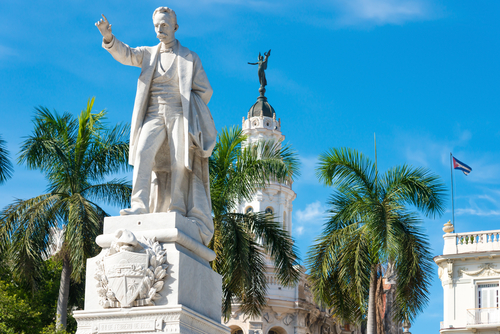
The José Martí Monument at Central Park in Havana, Cuba
The people of Cuba had lived under Spanish rule for centuries. The Cubans rebelled several times in the late 1800s, but each time the Spanish overpowered them and smashed their dreams of independence. José Martí, one of the heroes of the Cuban independence movement, fled to the United States to gather money, arms, and troops. In 1895, as economic conditions in Cuba worsened, Martí returned to Cuba to lead his people in a new revolt. Martí’s revolution led to terrible losses in human life and property. The rebels burned sugarcane fields and destroyed buildings in hopes of forcing the Spaniards to leave. In retaliation, Spanish troops herded Cuban people into camps to separate them from the rebels and to break their morale. Thousands of Cubans died of starvation and disease.
The Cuban people’s struggle against Spain attracted much sympathy in the United States. Businesspeople worried about the destruction of trade and their loss of investments in Cuba. Government leaders were concerned about a rebellion so close to the United States. Many Americans were horrified by the atrocities against Cuban citizens and called for the government to do something about it. President Cleveland opposed any American involvement in Cuba. In March 1897, William McKinley became president. He, too, hoped the conflict could be settled peacefully.
The American press reported the unfolding tragedy in Cuba in graphic detail, and its coverage intensified the debate over America’s role in the crisis. Newspapers, including Joseph Pulitzer’s World and William Randolph Hearst’s Journal, tried to outdo each other with shocking reports on the revolution. This type of sensational, biased, and often false reporting, yellow journalism, played a major role in fanning the flames of prowar sentiment in the United States.
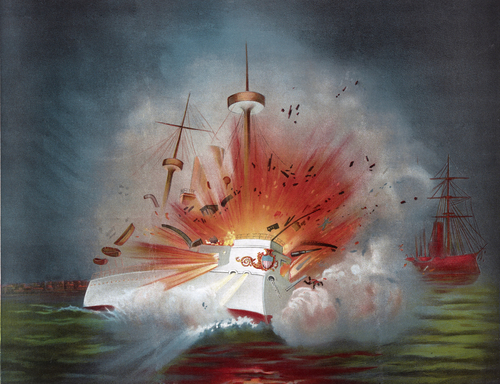
Artwork depicting the destruction of the USS Maine in Havana Harbor on February 15, 1898
The pressure on President McKinley to act seemed to grow by the hour. After rioting broke out in the Cuban capital of Havana in January 1898, McKinley sent the battleship U.S.S. Maine to protect American citizens and property. The ship remained quietly at anchor in Havana Harbor for three weeks. Then, on the night of February 15, 1898, an enormous explosion shattered the Maine, killing 260 officers and crew members. American newspapers immediately blamed the Spanish, and the slogan “Remember the Maine” became a rallying cry for revenge. Spain denied responsibility for the explosion.
Much later, evidence indicated that the explosion may have been accidental, but at the time, Americans clamored for war with Spain. After the Maine incident, McKinley sent the Spanish a strong note demanding a truce and an end to brutality against the Cubans. The Spanish agreed to some American demands, but not enough to satisfy McKinley or Congress. On April 19 Congress recognized Cuban independence. It also demanded the withdrawal of Spanish forces and authorized the president to use the army and navy to enforce American aims. On April 25, 1898, Congress declared war on Spain.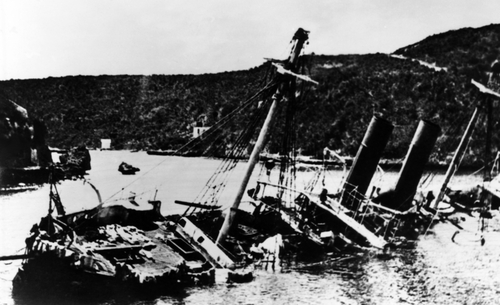
A U.S. naval squadron commanded by George Dewey sunk a Spanish fleet in Manila Bay, Philippines, during the SpanishAmerican War in 1898.
Although events in Cuba triggered the Spanish-American War, the war’s first military actions happened thousands of miles away in the Spanish colony of the Philippines. These islands served as a base for part of the Spanish fleet. In late February 1898, Assistant Secretary of the Navy Theodore Roosevelt had wired Commodore George Dewey and his squadron of navy vessels to prepare for action in the Philippines “in the event of declaration of war.”
In the early morning hours of May 1, Dewey launched a surprise attack on the Spanish fleet in Manila Bay, destroying most of the ships. American troops arrived in July. With the help of Filipino rebels led by Emilio Aguinaldo, the Americans captured the city of Manila. As in Cuba, the Filipino rebels had struggled for years to win independence from Spain. Using American-supplied arms, they seized the main island of Luzon, declared independence, and created a democratic republic. The rebels expected the United States to support their independence. However, the United States debated what to do with the islands.
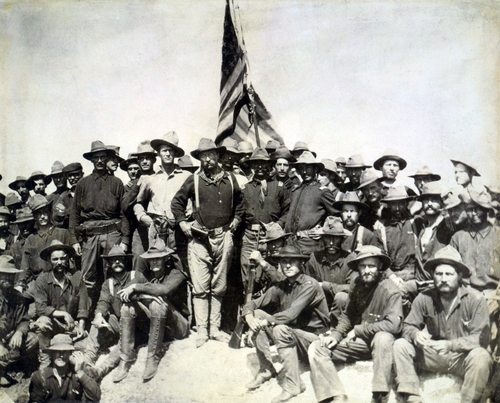
Colonel Roosevelt and his Rough Riders at the top of the hill they captured in the Battle of San Juan Hill during the Spanish-American War
Meanwhile in the Caribbean, a Spanish fleet entered the harbor of Santiago on the southeastern shore of Cuba on May 19. Several days later, an American naval force blockaded the coast, trapping the Spanish in the harbor. An American land force of about 17,000, nearly a quarter of them African American, landed near the city of Santiago. The inexperienced, ill-equipped Americans disembarked while forces under Cuban general Calixto García drove off the Spanish soldiers. Heavy fighting followed.
Theodore Roosevelt resigned his position as assistant secretary of the navy to join the fighting in Cuba. He led the First Regiment of U.S. Cavalry Volunteers, an assorted group of former cowhands and college students, popularly known as the Rough Riders. On July 1, the Rough Riders, with African American soldiers of the Ninth and Tenth Cavalries, joined the Battle of San Juan Hill. “I waved my hat and we went up the hill with a rush,” Roosevelt wrote later.
The Americans captured San Juan Hill after intense fighting. Two days later the Spanish fleet attempted to break out of Santiago. In a battle that lasted about four hours, the Spanish fleet was destroyed. This defeat ended Spanish resistance in Cuba. The United States then turned its attention to the Spanish colony of Puerto Rico, east of Cuba. American troops landed on Puerto Rico in late July and quickly took control of the island. On August 12, the Spanish signed an armistice, or a peace agreement, ending the war.
War Results
Secretary of State John Hay called the Spanish-American War “a splendid little war.” The war lasted fewer than four months, and about 400 Americans were killed in battle or died from wounds received in the fighting. Yet the war had other aspects that were not at all “splendid.” More than 2,000 Americans died of diseases such as yellow fever, malaria, and other diseases contracted in the tropical climate. The African Americans who served faced the additional burden of discrimination. Serving in segregated units, African Americans battled alongside the Cuban rebel army, in which black and white troops fought as equals.
The United States and Spain signed the Treaty of Paris on December 10, 1898, marking the official end of the war. The treaty dissolved most of the Spanish empire. Cuba became an American protectorate, a country that is technically independent but under the control of another country. Puerto Rico and the Pacific island of Guam became territories of the United States. Spain also surrendered the Philippines to the United States in exchange for $20 million. The American empire had become a reality, and with the empire came new responsibilities.
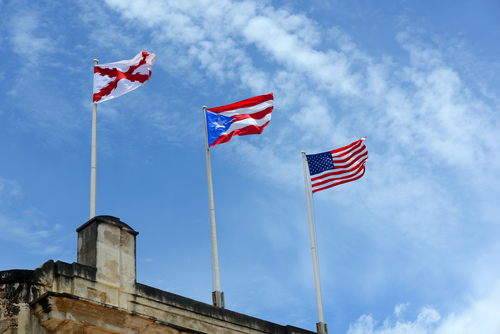
Flags fly at Castillo de San Cristóbal in San Juan, Puerto Rico. The three flags from left to right are the Burgundy Cross flag (used by the Spanish military from the 15th century to 1843), the flag of Puerto Rico, and the flag of the United States of America.
Americans debated what to do about Cuba. Many congressional leaders believed that the Cubans were not ready for complete self-government. American business leaders feared that leaving Cuba might weaken the political stability of Cuba and jeopardize American interests there. While Congress considered the matter, American troops remained in Cuba. Finally, in 1901, the United States agreed to grant Cubans full independence, but only if their new constitution included clauses giving the United States certain rights.
Known as the Platt Amendment, these clauses prohibited Cuba from making treaties with other nations and gave America control of a naval base at Guantanamo Bay. The Platt Amendment also gave the United States the right to intervene in Cuban affairs if the country’s independence was threatened.
After the war, Puerto Rico remained under direct military rule. In 1900, the United States set up a new Puerto Rican government under the Foraker Act. The American government controlled the new administration. In 1917, the Jones Act made Puerto Rico a territory of the United States and granted American citizenship to all Puerto Ricans. However, many Puerto Ricans still wanted independence.
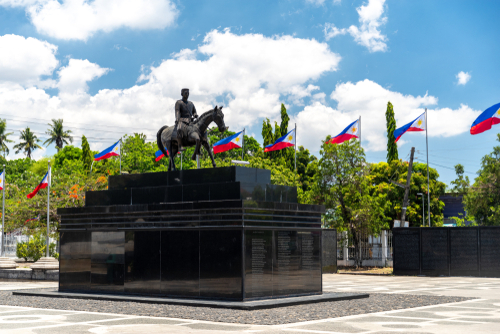
A statue honoring Emilio Aguinaldo in Kawit, Cavite, Philippines
The United States had gained possession of the Philippines in the treaty that ended the Spanish-American War. But acquisition of the Philippines aroused fierce debate. During the 1890s some people, anti-imperialists, opposed the American enthusiasm for foreign expansion and the Spanish-American War. After the war, the anti-imperialists fought approval of the treaty. Some argued that American rule of the Philippines contradicted the principles on which the United States was founded. Others opposed the large standing army that would be necessary to control the Philippines. Still others feared competition from Filipino laborers.
Many Americans, including Carl Schurz, Andrew Carnegie, and Mark Twain, joined the anti-imperialist campaign. The imperialists, however, led by Senators Henry Cabot Lodge and Albert Beveridge, eventually won out. The Senate ratified the Treaty of Paris on February 6, 1899. In February 1899, Emilio Aguinaldo’s forces began a fight for independence. This conflict became a mammoth undertaking for the United States. More than 4,000 Americans died. Filipinos suffered far greater casualties—at least 200,000 soldiers and civilians died.
When Aguinaldo was captured in March 1901, many Filipino military officers and soldiers surrendered. Others refused to give up even after Aguinaldo urged them to stop fighting. In the summer of 1901, the United States transferred authority in the Philippines from the military to a civilian government headed by William Howard Taft. Taft set out to prepare the islands for eventual self-rule. However, the Philippines did not gain full independence until 1946.
Who led the revolt against Spanish rule in Cuba in 1895? How did the Spanish retaliate?
For each group of Americans, tell why they had sympathy for the Cubans.
a. business people
b. government leaders
c. other Americans
How did the press increase prowar feelings in the United States?
William McKinley sent the battleship Maine to Havana Harbor in 1898 to protect American lives and property after rioting broke out. Explain the events behind and the significance of the slogan “Remember the Maine.”
What three things did Congress do on April 19, 1898?
When did Congress declare war on Spain?
What happened early on May 1, 1898? What happened at San Juan Hill on July 1, 1898?
Where did the United States turn its attention after Cuba?
When did the war end? Why did John Hay call the war “a splendid little war?”
The United States signed the Treaty of Paris on December 10, 1898. What were the terms of that treaty?
What was the Platt Amendment?
Who led the revolt against American rule in the Philippines?
| Your Responses | Sample Answers |
|---|---|
| Jose Marti; by herding Cubans into camps where thousands died of starvation and disease | |
| a. They worried about loss of investments in Cuba and destruction of trade. b. They were concerned about a rebellion so close to America. c. They were horrified by the atrocities against Cuban citizens. | |
| by practicing yellow journalism | |
| to protect American lives and property after rioting broke out in Havana; the Maine exploded on February 15, 1898, and the press blamed the Spanish. The slogan became a rallying cry for revenge. | |
| recognized Cuban independence; demanded the withdrawal of Spanish forces; and authorized the president to use the army and navy to enforce American aims | |
| April 25, 1898 | |
| George Dewey led a surprise attack on the Spanish fleet in Manila Bay; Theodore Roosevelt led the Rough Riders in a charge up San Juan Hill | |
| Puerto Rico | |
| August 12, 1898; it lasted fewer than four months, and about 400 Americans were killed or died | |
| Puerto Rico and Guam became territories of the United States. Cuba became an American protectorate. Spain sold the Philippines to the U.S. for $20 million. | |
| clauses in Cuba’s constitution giving the U.S. certain rights | |
| Emilio Aguinaldo | |
