The United States had been interested in the Hawaiian Islands since the early 19th century. It was the perfect climate for growing sugar and other crops, and it was also a strategic location in the Pacific Ocean. After the Civil War, Americans were enticed to move to Hawaii to grow sugar. But with high tariffs placed on foreign goods, many became a proponent of making Hawaii a part of the United States.
There was great debate over whether to annex Hawaii. Annexation means to incorporate (territory) into an existing political unit, such as a country. At times, annexation is done through military force.
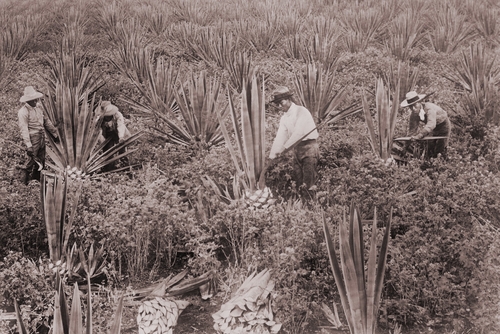
Japanese Americans on a sisal plantation in Hawaii around 1915
The lush Hawaiian Islands, a chain of 8 large and 100 or so smaller islands, lay about 2,000 miles west of California. The Hawaiian people lived in independent communities, each with its own chieftain, and lived by farming and fishing. American trading ships and whalers often stopped at the islands to take on supplies and fresh water. In the 1790s, Americans began trading with the Hawaiians for local resources. About that same time, King Kamehameha I unified the islands. Villages with good ports such as Honolulu and Lahaina began to grow in importance, and trade increased. However, American and European ships also brought infectious diseases to the islands. These diseases devastated the island population just as they had once devastated the Native Americans.
In 1820, Christian missionaries from the United States began arriving in Hawaii. They established schools, created a written Hawaiian alphabet, and translated the Bible into Hawaiian. Increasing numbers of American merchants in the whaling trade came to settle there, too. An American firm introduced sugarcane in Hawaii in the 1830s, and the missionaries and traders began buying land and establishing sugar plantations. The sugar industry grew quickly, and plantation owners brought in thousands of immigrants from Japan, China, and other Pacific lands to work in the fields. Gradually, the Americans took control of most of the land and businesses.
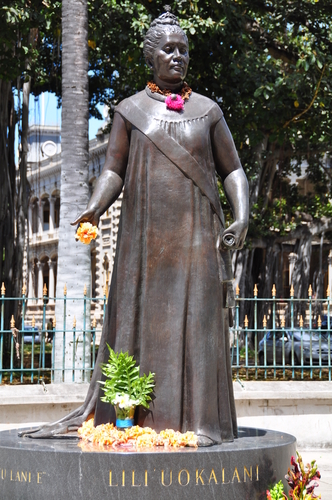
A statue of Queen Lili'uokalani outside the Hawaii State Capitol building in Honolulu
Americans also influenced Hawaiian politics, serving as advisers to the Hawaiian ruling family. Although the United States recognized Hawaiian independence in 1842, the islands came increasingly under American influence. Secretary of State William H. Seward believed the United States could build its empire in Hawaii and other regions through trade. The Pacific region played a key part in Seward’s plan. In 1867, Seward acquired the two small Pacific islands of Midway. He thought that these islands, more than 3,000 miles west of California, would serve as an important stopping place for American ships on the way to China.
American merchants and the United States Navy would need more than two small islands, however, to establish a secure foothold in the vast stretches of the Pacific. In 1875, the United States agreed to allow Hawaiian sugar to enter the country without tariffs. As sugar exports to the United States soared, American planters in Hawaii reaped enormous profits. In 1887, in return for renewal of the trade agreement, the United States pressured King Kalakaua to allow it to establish a naval base at Pearl Harbor, the best seaport in the islands.
In the early 1890s, under pressure from American sugar producers, Congress revised the tariff laws and eliminated the exemption for Hawaiian sugar. As a result, Hawaiian sugar planters had to drop their prices drastically to sell any sugar. Sugar exports to the United States dropped sharply. Facing ruin, the planters plotted a way to avoid the new tariff. They decided to make Hawaii a territory of the United States.
The Hawaiians, meanwhile, had begun to resist the growing influence of Americans. In 1891, Queen Liliuokalani came to the throne. The new ruler wanted Hawaiians to regain economic control of their islands, and she took away powers that the American sugar planters had held. In response, the white planters overthrew Liliuokalani and set up their own provisional, or temporary, government in 1893. The queen left under protest.

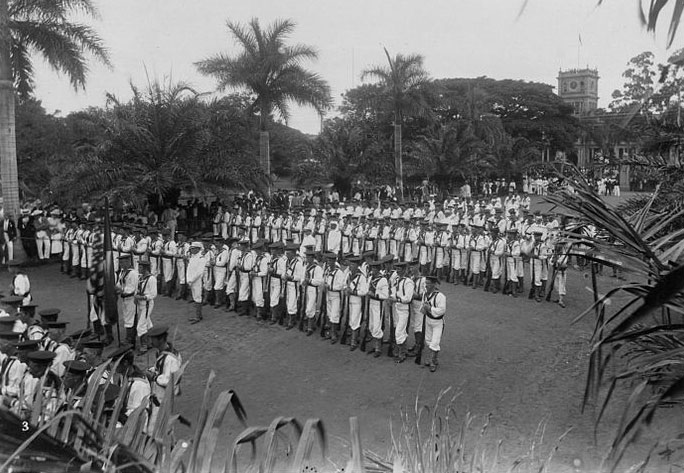
On August 12, 1898, the flag of the Kingdom of Hawai'i over 'Iolani Palace was lowered to raise the United States flag, signifying annexation.
The success of the planters’ revolt came in part from the support of the main American diplomat in Hawaii, John Stevens, who arranged for marines from the warship Boston to assist in the uprising. Stevens immediately recognized the new government, which sent a delegation to Washington to seek a treaty of annexation that would add Hawaii to the United States. President Benjamin Harrison signed the treaty during the final days of his administration and forwarded it to the Senate for approval.
However, the Senate did not act quickly enough. It failed to ratify the treaty before Harrison left office. The new president, Grover Cleveland, opposed annexation and withdrew the treaty from the Senate after discovering that Hawaiians did not support the revolt. Cleveland called American interference in the Hawaiian revolution “disgraceful.” Although most of the Hawaiians and the Asian immigrants in Hawaii opposed annexation, their opposition made no difference. A small, powerful group of American sugar growers, traders, and missionaries and their Hawaiian allies, along with influential people in the United States, had the final word. Congress approved the annexation of Hawaii in 1898, after William McKinley became president. In 1900, Hawaii became a territory of the United States.
