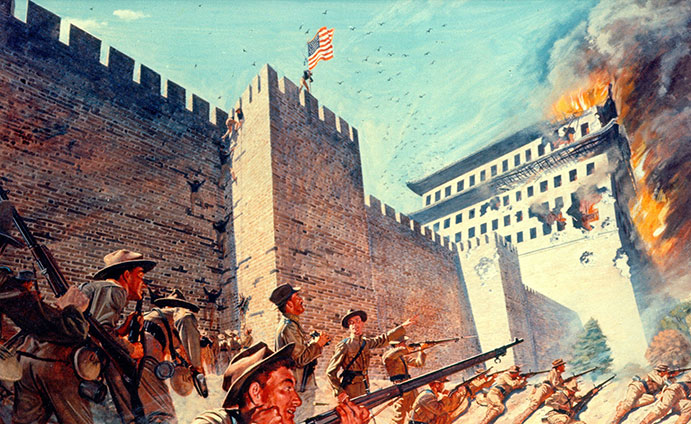
U.S. forces scale the walls of Peking, China, during the Boxer Rebellion.
During the era of American expansion, Asia, the most populous continent and a potentially huge economic market, proved irresistible to the United States. In 1854, Japan was forcibly made to trade with the United States. Then in the 1890s, the Spanish-American War brought the Asian lands of Guam and the Philippines under U.S. control as territories. These new holdings provided supply routes and defense locations, so ports of trade and naval bases became crucial.
And then there was China. In 1900, the country was ruled by an emperor. Colonial powers, such as Britain, France, and Russia, established trading entities within China called spheres of influence. America wanted in, too, and negotiated for open trade with all powers in China.
In 1900, during the Boxer Rebellion when Chinese nationalists attacked Western property, the United States sent in armed forces to repel the Boxers. This marks the first time the U.S. invaded another continent without aiming to acquire the territory.

A painting by Hibata Ōsuke depicts U.S. Commodore Matthew Perry's second visit to Japan, in 1854.
In the mid-1800s, American merchants carried on a profitable trade with China and hoped to expand trade in other areas of the world. Many wanted to open trading relations with Japan, which had long been isolated from the West. In 1853, President Fillmore sent Commodore Matthew Perry on a mission to Japan. After steaming into Tokyo Bay with four warships, Perry asked the Japanese to open their ports to U.S. ships. He told them he would return in several months for their answer.
The American show of force alarmed the Japanese. When Perry returned in 1854, the Japanese signed the Treaty of Kanagawa and opened two ports to American ships. Perry’s successful mission began a period of trade between Japan and the United States. It also marked the start of greater American involvement in Asia.
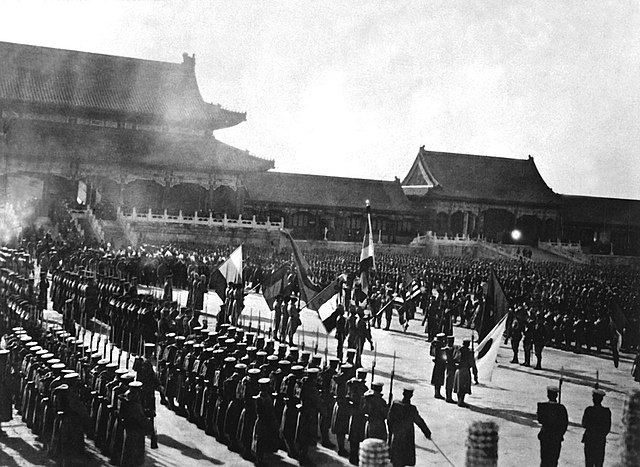
Foreign armies in Beijing, China, during the Boxer Rebellion
For Americans, the island territories in the Pacific, while important in themselves, represented stepping-stones to a larger prize: China. Torn apart by warring factions and lacking industry, China was too weak to resist the efforts of foreign powers that wanted to exploit its vast resources and markets. By the late 1890s, Japan and the leading European powers had carved out spheres of influence in China, sections of the country where each of the foreign nations enjoyed special rights and powers. Japan held the island of Formosa and parts of the Chinese mainland. Germany controlled the Shandong area in east-central China. Great Britain and France held several Chinese provinces, and Russia moved into Manchuria and other areas in northern China.
In the United States, some government and business leaders worried about being squeezed out of the profitable China trade. Although the United States could not force the other foreign powers out of China, Secretary of State John Hay wanted to protect and expand American trading interests in the country. Hay proposed an Open Door policy under which each foreign nation in China could trade freely in the other nations’ spheres of influence.
The other major powers were reluctant to accept a policy that would benefit the United States most of all. The situation soon changed, however. Beginning in late 1899, a secret Chinese martial arts society, known as the Boxers, led a violent uprising against the “foreign devils” in China. Many died and, for nearly two months, hundreds more were trapped in the besieged capital city of Beijing. Finally, in August 1900, foreign troops broke the siege and defeated the Boxers. Out of the Boxer Rebellion came a second Open Door proposal, which stressed the importance of maintaining China’s independence and respecting its borders. Alarmed by the rebellion, the other foreign powers accepted Hay’s policy.

The Great White Fleet leaving San Francisco, California, en route to Honolulu, Hawaii, on July 7, 1908
Eager to expand its power in Asia, Japan began to ignore the Open Door policy. Japan’s actions led to war with Russia and conflict with the United States. In the early 1900s, Japan and Russia clashed over Manchuria, a Chinese province rich in natural resources. On February 8, 1904, Japan launched an attack on the Russian fleet at Port Arthur in southern Manchuria, starting the Russo-Japanese War. By the spring of 1905, both Japan’s and Russia’s resources were nearly exhausted, and both countries were eager to make peace.
President Theodore Roosevelt offered to meet with their leaders in Portsmouth, New Hampshire, to help settle the conflict. In September 1905, Japan and Russia signed the Treaty of Portsmouth, which recognized Japan’s control of Korea in return for a pledge by Japan to halt its expansion. Roosevelt hoped the treaty would preserve a balance of power in Asia, but it failed to do so. He did win a Nobel Prize for his effort, however. Japan emerged as the strongest naval power in the Pacific, and it challenged the United States for influence in the region. Relations between the two nations deteriorated steadily.
During the Russo-Japanese War, Japanese immigration to the United States—especially to California—increased. Many Americans resented the Japanese newcomers, claiming that they took jobs from Americans. In 1906, the San Francisco Board of Education ordered that all Asian students attend separate schools. The Japanese government protested. An 1894 treaty had guaranteed that Japanese living in the United States would be treated well. The Japanese felt that the treaty had been broken. President Roosevelt forced the San Francisco school board to change its policies. In return, he persuaded Japan to consent to an agreement, promising to restrict emigration.
The Japanese resented the agreement and relations between the two nations worsened. Some Americans called for war. Although Roosevelt had no plan for war, in 1907 he sent 16 gleaming white battleships on a cruise around the world to display the nation’s naval power. The “Great White Fleet” greatly impressed the Japanese. By 1909, the United States and Japan had resolved many of their differences.
