The Monroe Doctrine, passed in 1823, stated that the United States controlled the countries in the Western Hemisphere. The Western Hemisphere is often defined in a political sense as including just North America, Central America, and South America. This document remained largely ignored until Theodore Roosevelt's presidency.
In the Spanish-American War, the U.S. showed its military strength. Now, under Roosevelt, the U.S. began to reassert their control over the countries in the Western Hemisphere, particularly in Central and South America.
For instance, even though the U.S. had granted Cuba independence, the Platt Amendment made certain the U.S. still had control over the country.
President Roosevelt thought the Monroe Doctrine, which blocked further expansion of Europe in the Western Hemisphere, did not go far enough. He added a corollary, or addition, to the doctrine that went one step further. Should any Latin American nation engage in "chronic wrongdoing," a phrase that included large debts or civil unrest, the United States military would intervene.
Not surprisingly, the countries of Latin America were not thrilled with the corollary. By the end of the 20th century, the U.S. had sent troops to intervene in Latin America over 35 times. This enlarged U.S. influence, but it also brought condemnations of "Yankee imperialism."
View the political cartoon below and then answer the questions that follow.
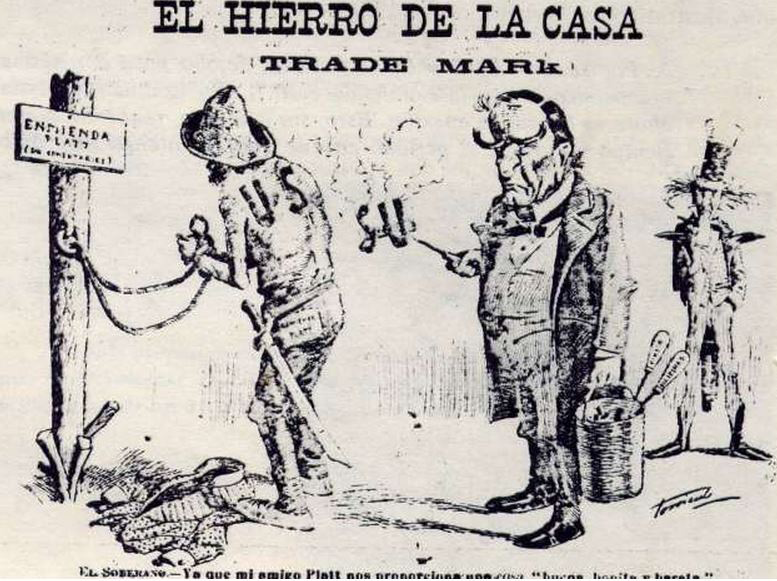
Who or what do you think the man chained to the post represents?
Who is the man standing in the background and what does he represent?
What is the cartoon saying about the Platt Amendment?
| Your Responses | Sample Answers |
|---|---|
| Cuba | |
| Uncle Sam, America | |
| The Platt Amendment brands Cuba as an American territory without their permission. | |
