Consider regular hexagon ABCDEF again.
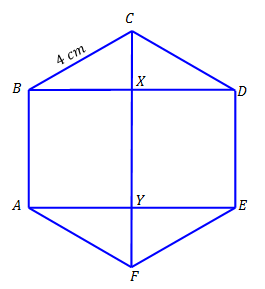
Earlier you proved that \(\small\mathsf{ \Delta {} }\)BXC \(\small\mathsf{ \cong {} }\) \(\small\mathsf{ \Delta {} }\)DXC. Use that process as an example and prove \(\small\mathsf{ \Delta {} }\)AYF \(\small\mathsf{ \cong {} }\) \(\small\mathsf{ \Delta {} }\)EYF. Construct your proof by answering the multiple choice questions below.
1. Are all sides of the hexagon congruent? Why or why not?
- Yes, all sides are congruent because the hexagon is regular.
- No, all sides are NOT congruent because the hexagon is regular.
- Yes, all sides are congruent because the hexagon is NOT regular.
Review the given information and remember the definition of regular.
Review the given information and remember the definition of regular.
Review the given information and remember the definition of regular.
2. Is ∠FAY \(\small\mathsf{ \cong {} }\) ∠FEY? Why or why not?
- No, the angles are not necessarily congruent because you know nothing about the triangle.
- Yes, the angles are congruent because they are base angles of an isosceles triangle.
- Yes, the angles are congruent because they are base angles of a right triangle.
What type of triangle is \(\small\mathsf{ \Delta {} }\)AEF, and what does that mean about the base angles?
What type of triangle is \(\small\mathsf{ \Delta {} }\)AEF, and what does that mean about the base angles?
What type of triangle is \(\small\mathsf{ \Delta {} }\)AEF, and what does that mean about the base angles?
3. The four outer triangles can be combined to form a rhombus.

Which statement is TRUE about the diagonals of a rhombus?
- The diagonals are supplementary to each other.
- The diagonals are parallel to each other.
- The diagonals bisect each other.
Review the theorems you proved for a rhombus
Review the theorems you proved for a rhombus
Review the theorems you proved for a rhombus
4. Is AY = YE? Why or why not?
- Yes, because AE is bisected by CF.
- No, because AE is bisected by CF.
- Yes, because AE is bisected by BD.
The diagonals of a rhombus bisect each other.
The diagonals of a rhombus bisect each other.
The diagonals of a rhombus bisect each other.
5. Why is \(\small\mathsf{ \Delta {} }\)BXC \(\small\mathsf{ \cong {} }\) \(\small\mathsf{ \Delta {} }\)DXC?
- By the definition of regular, the triangles are congruent.
- By SAS, the triangles are congruent.
- By supplementary regulations, the triangles are congruent.
Summary
 Questions answered correctly:
 Questions answered incorrectly:
By solving these problems, you practiced identifying a tile within a tessellation; you applied information about that tile to the entire tessellation, and you used a single tile to construct a proof.
