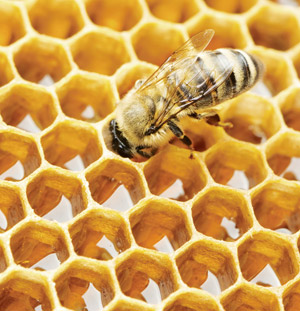
Tessellations are often found in nature. For instance, consider this honeycomb.
Question
What type of tessellation is the honeycomb?
The honeycomb is a regular tessellation because it's composed of regular hexagons.
You recognize the repeated hexagonal pattern, but what can you do with it? Work the problems in the slide show to find out.
Construct the Proof
Find the Length
Make a Honeycomb
Honeycomb Dimensions
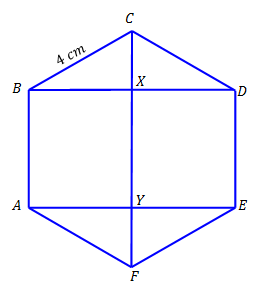
Tessellations are useful because they contain repeating polygons. Therefore, you can often analyze a small part of the tessellation and then apply that analysis to the pattern as a whole. Consider hexagon ABCDEF below.
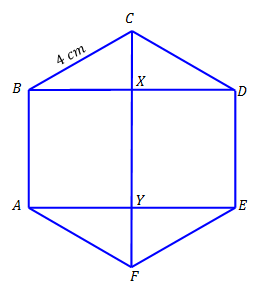
Assume this regular hexagon represents a single unit in a honeycomb. In other words, this hexagon is a tile in the tessellation. The length of side BC is 4 cm. Prove \(\small\mathsf{ \Delta {} }\)BXC \(\small\mathsf{ \cong {} }\) \(\small\mathsf{ \Delta {} }\)DXC.
Construct your proof by following the steps in the table below.
| By the definition of regular, all sides of the hexagon are congruent. By the definition of rectangle, segment XY is also congruent to the sides. |
|
| Consider isosceles \(\small\mathsf{ \Delta {} }\)BCD. By definition of isosceles, the base angles are congruent. | Therefore, ∠CBD \(\small\mathsf{ \cong {} }\) ∠CDB. |
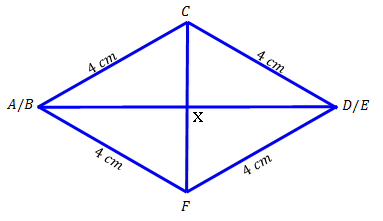
| The four outer triangles can be combined to form a rhombus. |
|
| By definition of rhombus, the diagonals bisect each other. | Therefore, BX = XD. |
| By SAS, the triangles are congruent. | Therefore, \(\small\mathsf{ \Delta {} }\)BXC \(\small\mathsf{ \cong {} }\) \(\small\mathsf{ \Delta {} }\)DXC. |
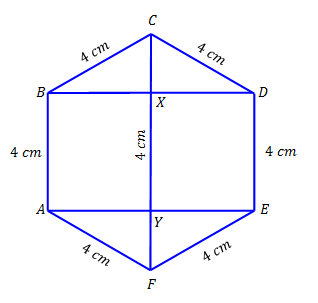
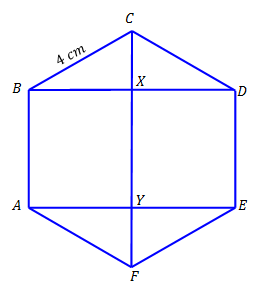
In hexagon ABCDEF, you know the outer four triangles are congruent based on the previous proof. Now, assume the length of diagonal BD is 6 cm. What is the length of diagonal CF?
Work this problem by following the steps in the next table.
| The four outer triangles can be combined to form a rhombus. |
|
| The diagonals of a rhombus bisect each other. Therefore, CF bisects BD, and BX = XD = 3 cm. |
|
| The diagonals of a rhombus are perpendicular to each other. | Therefore, ∠BXC = ∠DXC = 90°. Also ∠AYF = ∠EYF = 90° |
| The hexagon contains rectangles ABXY and EDXY. | Therefore, BX = AY = 3 cm and XD = YE = 3 cm. |
| Because the hexagon contains right triangles, use the Pythagorean Theorem to calculate the unknown sides. | CX = YF = \(\small\mathsf{ \sqrt {(4^{2} - 3^{2})} = 2.6 cm. }\) |
| Add the segments to find the length of CF. | CF = CX + XY + YF = 2.6 + 4 + 2.6 = 9.2 cm |
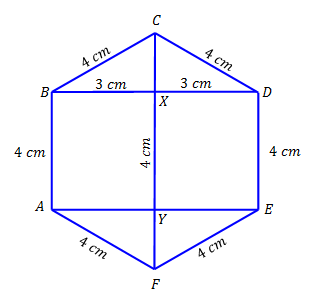
At this point, you know the lengths of several segments in hexagon ABCDEF.
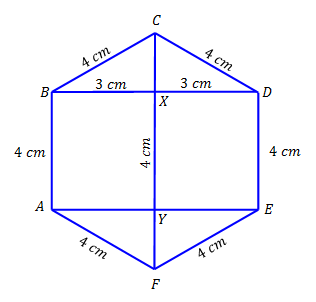
Use this single unit to form a tessallation and create a honeycomb.
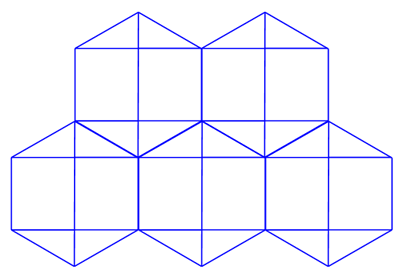
Build on the information you learned in the previous problems to find the height and width of the honeycomb.
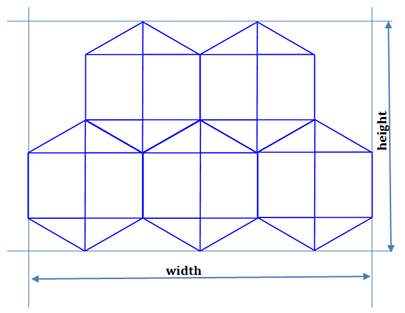
Use the steps in the following table to solve this problem.
| Compare the tessellation to the unit hexagon tile. |
|
| The height of the honeycomb is equivalent to CF + XY + YF. (Remember that YF = CX) | Height = 9.2 + 4 + 2.6 = 15.8 cm. |
| The width of the honeycomb is equivalent to (3)(BD). | Width = (3)(6) = 18 cm. |
By working on these problems, you first analyzed a single unit (or tile) in the honeycomb. Then, after replicating that tile, you were able to solve problems with the entire tessellation.
