Throughout this lesson, you've learned many concepts and worked several problems. You've identified tessellations and labeled them according to their tiles and pattern. You've analyzed individual tiles and then applied that analysis to the tessellation as a whole. You've also used tessellations to model problems in real life. At this point, make sure you understand the topics covered in this lesson by answering the questions below. If you miss any problems, make sure you go back and review the relevant concepts before your lesson quiz.
1. Which pattern is NOT a tessellation?
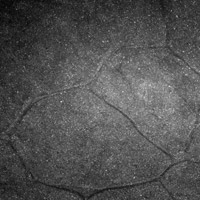
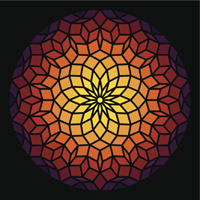
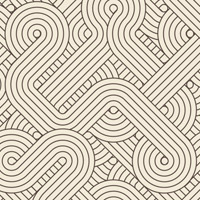

Which pattern has overlaps?
Which pattern has overlaps?
Which pattern has overlaps?
Which pattern has overlaps?
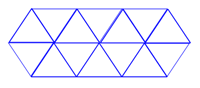
2. Which polygon is a unit tile in the tessellation above?
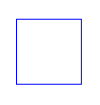
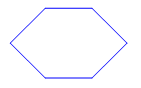
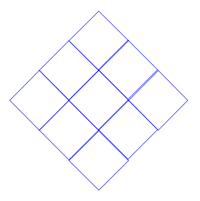

Which polygon is repeated several times?
Which polygon is repeated several times?
Which polygon is repeated several times?
Which polygon is repeated several times?
3. What is the area of \(\small\mathsf{ \Delta {} }\)BCX?
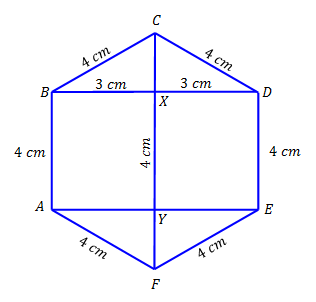
- 12 \(\small\mathsf{ cm^{2} }\)
- 4 \(\small\mathsf{ cm^{2} }\)
- 8 \(\small\mathsf{ cm^{2} }\)
- 7 \(\small\mathsf{ cm^{2} }\)
Find the height of the triangle. Then, calculate A = 1/2bh.
Find the height of the triangle. Then, calculate A = 1/2bh.
Find the height of the triangle. Then, calculate A = 1/2bh.
Find the height of the triangle. Then, calculate A = 1/2bh.
4. What are the dimensions (length x height) of this tessellation?
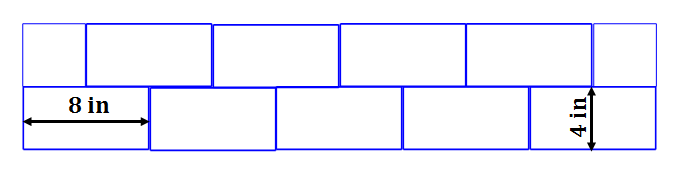
- 8 in x 4 in
- 40 in x 8 in
- 32 in x 8 in
- 40 in x 20 in
Multiply the dimensions of a single tile by the number of tiles in the tessellation.
Multiply the dimensions of a single tile by the number of tiles in the tessellation.
Multiply the dimensions of a single tile by the number of tiles in the tessellation.
Multiply the dimensions of a single tile by the number of tiles in the tessellation.
Summary
 Questions answered correctly:
 Questions answered incorrectly:
