Sarah was excited about spending her school break with her grandmother. She was tired of school, teachers, studying, everything! She planned to spend her entire break sleeping in, watching television, hanging with her friends, and relaxing. Sarah's grandmother, GiGi, had other plans.
As soon as Sarah walked into GiGi's home, they hugged each other warmly and sat down to chat. GiGi told Sarah, "I really need your help." Sarah figured that GiGi needed help sending a text message or finding something on the Internet and agreed immediately to do whatever GiGi needed. GiGi continued, "Can you please help me with my geometry assignment?"
Sarah's mouth dropped and her heart sank. She so desperately wanted a break from school, but she could never say no to her GiGi. Then, she became curious, and Sarah asked GiGi why she was taking geometry at her age. Surely a grandmother didn't need geometry in real life. GiGi explained that she grew up in a developing nation, and the people in her home country didn't believe in educating girls. As a child, GiGi had had a very hard life. She work long hours fulfilling domestic obligations, and she never had a chance to go to school. GiGi always dreamed of getting an education, and now she finally had the chance! Sarah admired her grandmother's tenacity, and she realized how she'd taken her own education for granted.
The two sat down at the kitchen table to work, and Sarah asked what they were studying. GiGi stated that she just didn't understand tessellations. Sarah began her tutoring session...
|
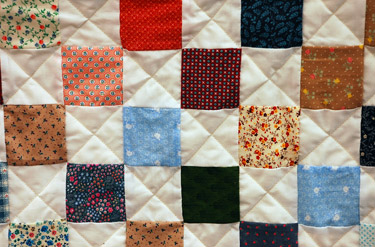
Sarah decided to use an example she knew her grandmother would understand. "Think about the patchwork quilt you made for Mom."
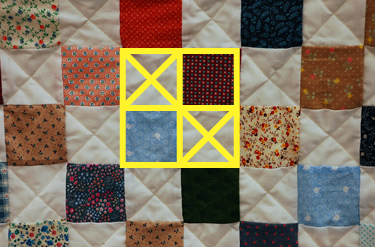
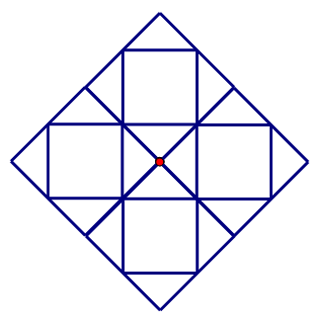
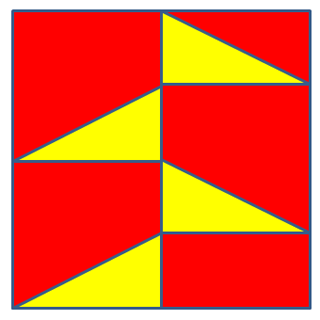
Each piece in the quilt came from fabric that was special to their family, but that's not what makes the quilt an example of a tessellation. Sarah told GiGi to look at the polygons that make up the quilt. Notice the pattern of squares and triangles that completely cover the quilt.
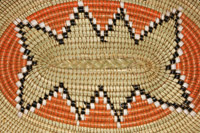
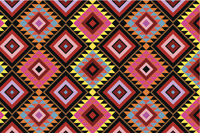
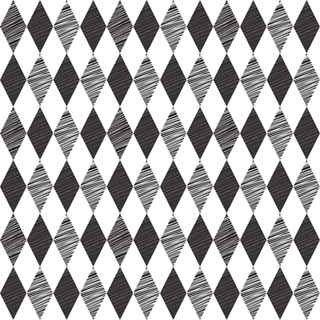
Based on this image, what is a tessellation? A tessellation is a plane that's covered by a pattern of geometric shapes with no overlaps and no gaps. Because tessellations are simply a repeated pattern with no overlaps and no gaps, you can find tessellations in everyday items, like the beads in this basket or the designs in this scarf.
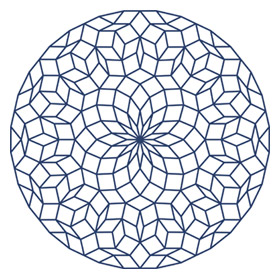
However, for the purpose of geometry, focus solely on tessellations composed of geometric patterns. Tessellations can be defined in two different ways. The first way is to define them by their tiling, i.e., the shapes that make up each tile. The quilt was an example of a regular tessellation because all the tiles contained regular polygons. Penrose tiles are another type of tessellation. Penrose tiles contain two different polygons arrange aperiodically.
Notice how the Penrose tiles create the illusion of circles, but upon close inspections, the tiles are actually triangles and rhombuses. The second way to define a tessellation is by the repetition of its geometric pattern. Tessellations can repeat by translation, rotation, or reflection. Click on the boxes below to see examples of each.
Suddenly, the concept clicked, and GiGi understood. A tessellation is simply a repeating geometric pattern with no overlaps and no gaps. They can be classified by the shapes that make up their tiles or by the way their tiles repeat. GiGi thanked Sarah for being an excellent tutor. |
 |

Tessellations are all around you, and they can serve as a useful geometric tool. Therefore, in this lesson, you'll learn how to use tessellations to model and solve real-life problems.
Question
What are two ways to classify tessellations?
Tessellations can be classified by how their tiles are shaped or by how their tiles repeat.
