Directions: The following question is based on Documents 1-7 in the tab set below. Write the essay and submit it to your instructor for grading.
This question is designed to test your ability to work with and understand historical documents.
Write an essay that:
- Has a relevant thesis and supports that thesis with evidence from the documents.
- Uses all of the documents.
- Analyzes the documents by grouping them in as many ways as possible. Does not summarize the documents individually.
- Takes into account the sources of the documents and analyzes the authors’ points of view.
- Explaining nuance of an issue by analyzing multiple variables
- Explaining both similarity and difference, or explaining both continuity and change, or explaining multiple causes, or explaining both cause and effect
- Explaining relevant and insightful connections within and across periods
- Confirming the validity of an argument by corroborating multiple perspectives across themes
- Qualifying or modifying an argument by considering diverse or alternative views or evidence This understanding must be part of the argument, not merely a phrase or reference.
You may refer to relevant historical information not mentioned in the documents.
Prompt:Evaluate the extent to which religion and ideology impacted society between 1200-1450.
Source: Excerpt from the book of the Turkish Admiral Sidi Ali Reis, entitled "Mirat ul Memalik" (the Mirror of Countries), describing the celebration of an Islamic festival by merchants in China.
Moreover, I was told in Gujarat, by the merchants Khodja Bashi and Kara Hasan (God alone knows whether their story is true), that when the Turkish merchants in China desired to insert the name of their [Turkish] Sovereign in the Bairam prayers on Bairamday, they brought the request before the Khakan of China, stating that their Sovereign was Padishah of Mecca, Medina, and the Kibla… and therefore entitled to have his name inserted in the Bairam prayers.
The Khakan, although an unbeliever, had insight enough to see the justice of their request, which he granted forthwith… Ever since that time the name of the Padishah of Turkey has been included in the Bairam prayers [in China].
Source: Abu Ubaydallah Al-Bakar, Muslim scholar living in Cordoba, Spain.
The king of Ghana, when he calls up his army, can put 200,000 men in the field… The city of Ghana consists of two towns situated on a plain. One of these towns, which is inhabited by Muslims, is large and possesses twelve mosques. When they assemble for the Friday prayer the king adorns himself like a woman, wearing necklaces round his neck and bracelets on his forearms, and he puts on a high cap decorated with gold and wrapped in a turban of fine cotton. Their religion is paganism and the worship of idols… They make sacrifices to their dead and make offerings of intoxicating drinks.
Source: Account by a Christian monk who served Kubilai Khan, describing encounters with the sons-in-law of Kubilai Khan during their travels from China to Jerusalem in the late 13th century.
“[The monks] selected for [the kings] gifts, namely, beasts on which to ride, and gold, and silver, and wearing apparel [and rugs]. Then the two monks said, "We have no need of any [of these things]. For what can we do with these possessions? And how can we possibly carry such a weight [as] this?"
And the kings mentioned above replied, "Ye have no knowledge of the length of this journey, and the expenses which it demands. We, however, do know, and we advise you not to set out empty [handed]; if ye do ye will be unable to arrive at the place which ye have decided to be your destination. Accept then these gifts from us as a lon (or trust), and if some occasion of necessity should befall you, spend what ye need from them; if, on the other hand, the necessity does not arise, and ye arrive safe and sound, distribute them among the monasteries and habitations of the monks which are there, and the Fathers (i.e. Bishops), so that we may enjoy association with our Western Fathers.”
Source: Notre-Dame-de-Paris by Noël Bellemare, ca. 1525
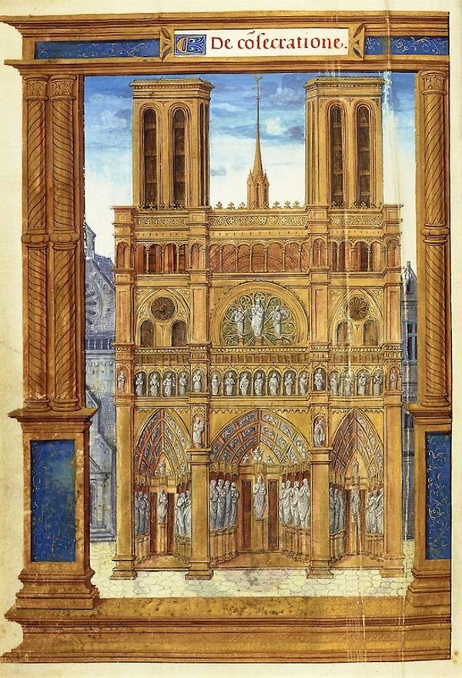
The Notre Dame de Paris, first completed in 1260, became a symbol of Western Christianity in Europe in the medieval period.
Source: Excerpts from Confucius on Five Relationships
“Let the ruler be a ruler, the subject a subject, the father a father, the son a son.”
“Truly if the ruler be not a ruler, the subject not a subject, the father not a father, the son not a son, then even if there be grain, would I get to eat it?”
“The Master said about government, ‘Encourage the people to work hard by setting an example yourself. Do not allow your efforts to slacken.’”
Source: Bentley, et. al Traditions and Encounters: A Global Perspective on the Past, excerpt from p. 433.
Ritual Bloodletting. Like their predecessors, the Mexica believed that their gods had set the world in motion through acts of individual sacrifice. By letting their blood flow, the gods had given the earth the moisture it needed to bear maize and crops. To propitiate the gods and ensure the continuation of the world, the Mexica honored their deities through sacrificial bloodletting. Mexica priests regularly performed acts of self-sacrifice…bloodletting rituals clearly reflected the desire of the Mexica to keep their agricultural society going.
Source: Marco Polo (through ghostwriter Rustichello), Italian merchant who spent 17 years in the court of Kublai Khan: A Description of the World, 1298.
The grand khan, having obtained this signal victory [over a challenger to his rule], returned to great pomp and triumph to the capital city…[as] was his usual practice [performing rituals for holy books] upon each Christian festivals…he observed the same at the festivals of the Saracens [Muslims], Jews, and idolators….
[After leaving the capital of Beijing] You arrive at the city of Kue-lin-fu…[where] the women…are very handsome, and live in a luxurious state….
Upon leaving the city …during which you are continually passing towns and castles, of which the inhabitants are idolaters, have silk in abundance, and export it in considerable quantities, you reach the city of Unguen. This place is remarkable for a great manufacture of sugar, which is sent…for the supply of the court. Previously to…being…under the dominion of the grand khan, the natives were unacquainted with the art of manufacturing sugar of a fine quality, and boiled it in such an imperfect manner, that when left to cool it remained in the state of a dark-brown paste…. But at the time when this city became subject to his majesty’s government, there happened to be at the court some persons from Babylon [Cairo, Egypt] who were skilled in the process…instructed the inhabitants in the mode of refining the sugar. …
[After] five days’ journey, you arrive at the noble city of Zai-tun , which has a port on the seacoast celebrated for…shipping, loaded with merchandise….The quantity of pepper imported there is so considerable that what is carried to Alexandria to supply the demand of the western parts of the world, is trifling in comparison….
The rubric below will be used to grade your essay.
| Reporting Category | Scoring Criteria | Decision Rules |
|---|---|---|
|
Thesis/Claim |
1 point Responds to the prompt with a historically defensible thesis/claim that establishes a line of reasoning. |
To earn this point, the thesis must make a claim that responds to the prompt rather than restating or rephrasing the prompt. The thesis must consist of one or more sentences located in one place, either in the introduction or the conclusion. |
|
Contextualization |
1 point Describes a broader historical context relevant to the prompt. |
To earn this point, the response must relate the topic of the prompt to broader historical events, developments, or processes that occur before, during, or continue after the time frame of the question. This point is not awarded for merely a phrase or reference. |
|
Evidence |
Evidence from the Documents
1 point Uses the content of at least three documents to address the topic of the prompt. OR 2 points Supports an argument in response to the prompt using at least four documents. |
To earn one point, the response must accurately describe — rather than simply quote — the content from at least three of the documents. To earn two points, the response must accurately describe — rather than simply quote — the content from at least six documents. In addition, the response must use the content of the documents to support an argument in response to the prompt. |
|
Evidence beyond the Documents
1 points Uses at least one additional piece of the specific historical evidence (beyond that found in the documents) relevant to an argument about the prompt. |
To earn this point, the response must describe the evidence and must use more than a phrase or reference. This additional piece of evidence must be different from the evidence used to earn the point for contextualization. |
|
|
Analysis and Reasoning |
1 point For at least two documents, explains how or why the document’s point of view, purpose, historical situation, and/or audience is relevant to an argument. |
To earn this point, the response must explain how or why (rather than simply identifying) the document’s point of view, purpose, historical situation, or audience is relevant to an argument about the prompt for each of the three documents sourced. |
|
1 point Demonstrates a complex understanding of the historical development that is the focus of the prompt, using evidence to corroborate, qualify, or modify an argument that addresses the question. |
A response may demonstrate a complex understanding in a variety of ways, such as: |
