Between 1538 and 1553, the great Ottoman emperor Suleiman the Magnificent launched four naval expeditions in the Indian Ocean in an attempt to drive out the Portuguese. Though the Ottomans did not succeed in eliminating Portuguese maritime trade routes, they did manage to keep control of the Arabian Peninsula and the Red Sea. Click through this slideshow to see where these battles took place and how they turned out.
|
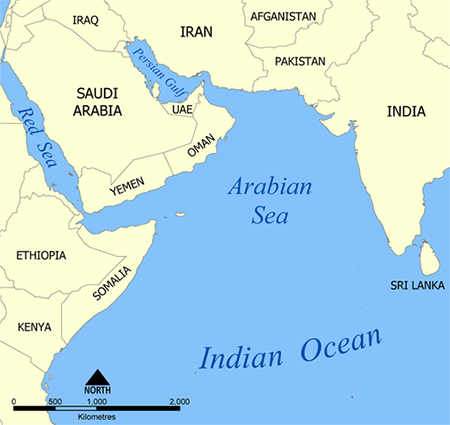
This map shows the region in the Indian Ocean where the Ottoman navy fought with the Portuguese between 1538 and 1553. Most of the battles occurred in the Arabian Sea near the entrances to the Red Sea and the Persian Gulf--and near the northern coast of India.
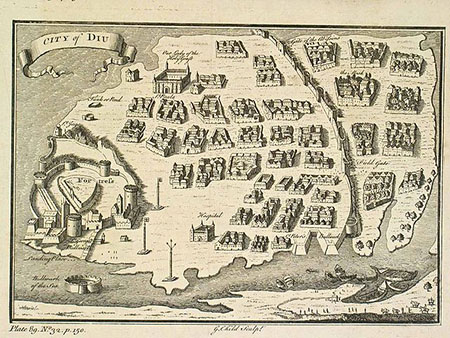
Suleiman's first expedition took place in 1538 when an Ottoman fleet under the command of Hadim Suleiman engaged the Portuguese at the city of Diu, on the northwest coast of India. Diu,shown in this early map, was a busy trading port that the Portuguese had seized in 1509. The city was well defended by a fort the Portuguese had constructed overlooking the harbor. The Ottomans failed to take the city, which remained under Portuguese control for another 464 years.
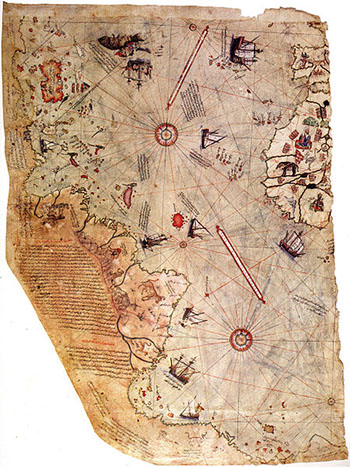
Between 1548 and 1552, the admiral Peri Reis established Ottoman control of the Red Sea area. He also attempted to rout the Portuguese from the islands of Hormuz and Bahrain in the Persian Gulf, though he was not completely successful. Reis, however, is remembered less for his naval battles than for his skill as a cartographer. In 1525, he published the Kitab-ı Bahriye, or Book of Navigation, one of the greatest books of early cartography ever assembled. It contained over 220 maps covering all areas of the globe. A copy of the first edition can be found in the British Museum today, and a fragment is shown here.
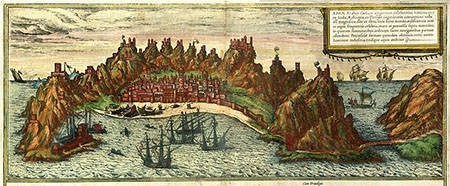
The Ottomans did manage to gain some ground on the Portuguese in 1538, when they took control of the city of Aden on the coast of Yemen, an important port town shown in this early illustration. Aden became a British Colony, though, in 1645.
In 1552, the commander Murat Reis the Elder engaged the Portuguese in a naval battle in the Persian Gulf. Though he defeated his rivals at this one battle, the Portuguese continued to pose a threat to Ottoman power in that area.
The last Ottoman expedition against the Portuguese was led in 1553 by Seydi Ali Reis, who restored the fleet in Basra and fought off Portuguese ships that threatened the shores of Oman. A storm destroyed most of his fleet and drove the surviving ships to India. The ships were in such poor condition that Seydi Ali and his men had to abandon them and return home by traveling overland. His book recounting that journey, Mirat ul Memalik, or Mirror of Nations, is considered a classic of Turkish literature.
|
 |

Question
Why were the Ottomans focused on attacking the Portuguese?
