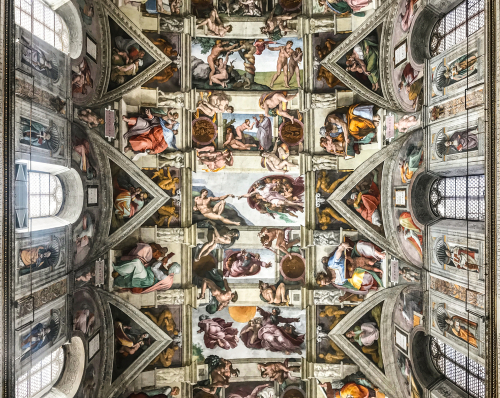
During the Renaissance, the word patron had a slightly different meaning. An artist's patron provided him with food, clothing, shelter, a studio, and, most important of all, recognition. Renaissance artists depended on such patronage to survive. After all, there were no galleries, no websites, and no federal grants. Instead, an artist's career and reputation were built upon commissions from wealthy patrons. A commission is a request for a particular piece of artwork, such as a portrait or a mural. A wealthy merchant, for instance, might commission a portrait of his wife to hang in his home. Or he might commission a sculpture for the altar in his church--to be donated in his name, of course.
Pope Julius II of the Catholic Church, with the Church's vast wealth under his control, became a patron of many artists, including Michelangelo. By the early 1500s, Michelangelo had become one of Italy's greatest artists. But the Pope's commissions were not always easy to carry out, as Michelangelo soon discovered. One request in particular worried him. The task was so daunting that he was sure he would fail. Learn more by reading these flashcards.
What was the commission from the Pope that Michelangelo found so challenging, and why?
To paint the entire ceiling of the Sistine Chapel in the Vatican; The challenges were many: It was fresco painting, it was high above the ground, and it was over 3,280 square feet—a huge space.
What is fresco painting?
Painting on fresh plaster before it dries; Michelangelo had 12 to 24 hours to finish painting a section on the ceiling before its plaster dried.
How did Michelangelo get his designs painted on the ceiling?
His assistants would spread the plaster over a section, then nail a sketch for that section over the plaster. They would poke holes along the outlines of the figures in that section, leaving holes in the plaster. Then they removed the sketch, and Michelangelo climbed up and painted in the figures using the holes as a guide.
Title or question
Why did Michelangelo hate working on the ceiling?
Although his painting was famous, Michelangelo saw himself as a sculptor, not a painter. He resented the enormous amount of time it took him to paint the ceiling.
Summary
 Correct:
 Incorrect:
What did the finished product look like? The ceiling of the Sistine Chapel is one of the greatest artworks in the world. It features the famous image of God giving life to Man.