Early Renaissance Awakening
From God’s Perspective
Giotto Changes Focus
Seeing is Believing
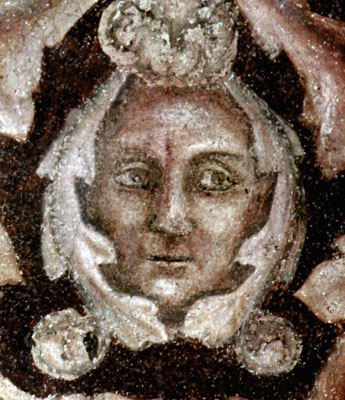
Giotto [Public domain], via Wikimedia Commons
The early Christian church had rejected all ancient, pre-Christian art as the work of the devil. Once the Church was strong, it no longer felt threatened by antiquity. Christian artists began to use ancient Greek and Roman techniques to create realistic, emotional art. Images now had movement and life—human life. Human energy flowed through religious figures, from the saints to God himself. The Italian painter Giotto (1266-1337), who historians think is shown in this mosaic, was one of the first artists to make this leap.
Did Giotto live during the Renaissance?

No. The Renaissance began in the late 1300s and early 1400s. That’s why Giotto’s work is unusual. He was ahead of his time.
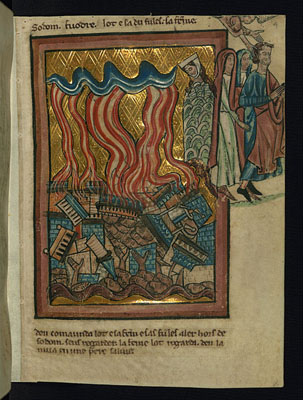
William de Brailes [Public domain or Public domain], via Wikimedia Commons
Why was the perspective in medieval Christian art so skewed? Why are people in the sky? Why are the hands of people buried under the rubble of a city (at the bottom) so big they go halfway up the city walls? It wasn’t that Christian artists were just untalented. There was a religious reason: Art was supposed to represent the perspective of God himself. Since God was everywhere, God could see things from every angle at once. How could an artist represent that? How could a scene be shown from the top, bottom, and all sides all at once? The medieval answer was to get rid of perspective altogether. Since no human could see as God saw, everything would be flat. Distance was shown by putting people in the sky. If humans could not see as God saw, then no one would see anything properly.
What did using this non-perspective rather than human perspective say about early Christian attitudes toward humanity?
Early Christian artists would rather have no perspective at all than use human perspective and imply it was better than God’s.
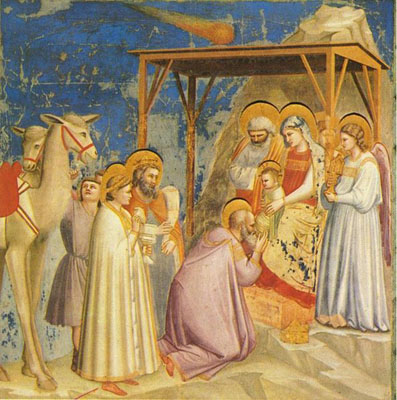
Giotto pioneered the use of human perspective. He did not try to erase perspective or see through God’s eyes. He created depth perception naturally. Here, Mary and Joseph are not in the sky to show that they are farther from the viewer than the wise men. Giotto made another big change: He dropped the church teaching that humans should only be represented as symbolic figures in art. If saints were shown in early Christian art, they all wore identical expressions of holy goodness, and they all stood in the same position. If sinners were shown, they all wore identical expressions of evil. Giotto created human figures with expressive human faces. They were individuals with different color hair, different ages, different emotions. The figures in this painting could have been modeled on citizens of Florence.
What is a particularly realistic, human touch in this painting?
A man reaching up to pet a camel.
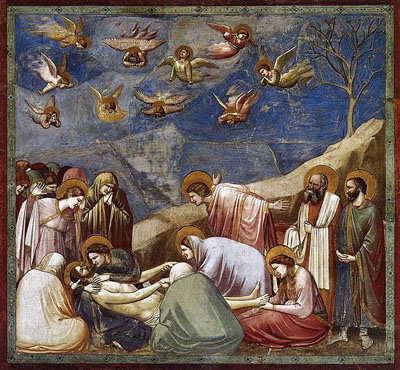
Giotto [Public domain], via Wikimedia Commons
In Giotto’s work, humanity can be beautiful—so beautiful that even angels and saints have taken on human form. Only their halos show us that some of these figures are not human beings. Giotto even has two people with their backs turned and heads covered. This posture of grief makes them even more real.
Why is it okay that there are figures in the sky in this painting?
They are angels, and are supposed to be flying through the sky. They look like something a human would look up and see above.
