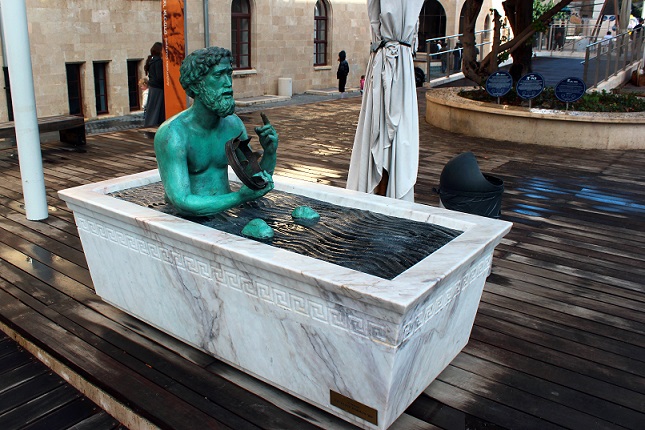
Roughly 2,500 years ago, two Greeks, Aristotle and Archimedes, made discoveries because they were curious about why certain things in their world behaved as they did. Aristotle was considered the "father of philosophy" because he started teaching people methods of inquiry. Archimedes was a mathematician and physicist who is most well known for his principle to find the volume of an object with an irregular shape. This is likely why he was immortalized in statue form in a bathtub!
The philosophers had a passionate curiosity that spurred them into action. This is what distinguishes scientists from others. People knew these things happened—the sunrise, sunset, seasons of the year, and movement of stars in the sky—but these scientists wanted to know how and why. Once scientists started paying attention to these observations and answering the questions why and how, people could start to accurately predict these events. Through science, we began to see relationships in nature and have a very primitive understanding of them. This understanding gave people a greater feeling of control over their lives. This curiosity was the birth of science.
So, what is this science that Archimedes represents? Physics is defined as the study of the nature and properties of matter and energy. In this field, we asked fundamental questions and try to answer them through observation and experimentation. The field is always changing—each day there are new discoveries that redefine what we already know. New theories come alive as we gather more and more information about the world around us. Then, even more questions are birthed. The study of physics is never-ending.
