As Americans began to expand westward in the 19th century, they continued moving into Native American territory. Many Native Americans had already moved further west as American's confiscated their lands in the east. Now tribes had few places left to live. Americans felt it was their destiny to move west and cultivate lands, even if that meant taking more land from the natives.
Native Americans fought back. In northwestern Ohio, a confederation of tribes was formed by a Native American warrior named Tecumseh and his brother, Tenskwatawa. Together they organized many tribes and created a coalition of thousands of warriors mostly from the Shawnee tribes. They fought the Americans in several battles in Ohio and Indiana. However, the Native Americans did not win.
Read the following information about the Native American resistance. Take notes as you read.
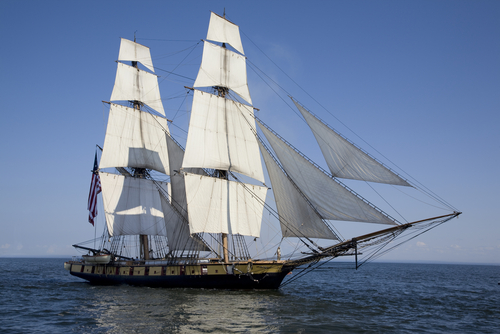
In the late 1700s, American merchant ships sailed far and wide, making stops in South America, Africa, and lands along the Mediterranean Sea.
Despite the dangers of sea travel in the early 1800s, the livelihoods of many Americans depended on trade with foreign nations. In 1785, the American ship Empress of China returned to New York from China with a highly prized cargo of tea and silk. The goods sold for a large profit. Soon, ships from New York, Philadelphia, and especially New England were sailing regularly to China and India carrying furs and other goods. In the following years, American merchant ships sailed far and wide, making calls in South America, Africa, and lands along the Mediterranean Sea.
War between the French and British in the mid-1790s gave an additional boost to American shipping. Rather than risk capture or destruction by the enemy, many French and British merchant ships remained at home. American shippers profited from the situation and increased their trade. By 1800, the United States had almost 1,000 merchant ships trading around the world.

Commodore Edward Preble's squadron engaging the Tripolitan gunboats and fortifications on August 3, 1804
Sailing in foreign seas was not without danger. In the Mediterranean, for example, ships had to be on guard for pirates from Tripoli and the other Barbary Coast states of North Africa. For years, these Barbary pirates had been terrorizing the Mediterranean. They demanded tribute, or protection money, from European governments to let their ships pass safely. The United States, too, had paid tribute for safe passage, but not enough. In 1801, the ruler of Tripoli asked for more money from the United States. When President Jefferson refused, the ruler chopped down the flagpole of the American consulate, a declaration of war. Jefferson sent ships to the Mediterranean and blockaded, or closed off, Tripoli. The American fleet, however, was not powerful enough to defeat the Barbary pirates, and the conflict continued.
In 1804, the pirates seized the U.S. warship Philadelphia and towed it into Tripoli Harbor. They threw the captain and crew into jail. Stephen Decatur, a 25-year-old United States Navy captain, acted. Slipping into the heavily guarded harbor with a small raiding party, Decatur burned the captured ship to prevent the pirates from using it. A British admiral praised the deed as the “most bold and daring act of the age.” Negotiations finally ended the conflict with Tripoli in June 1805. Tripoli agreed to stop demanding tribute, but the United States had to pay a ransom of $60,000 for the release of the American prisoners.
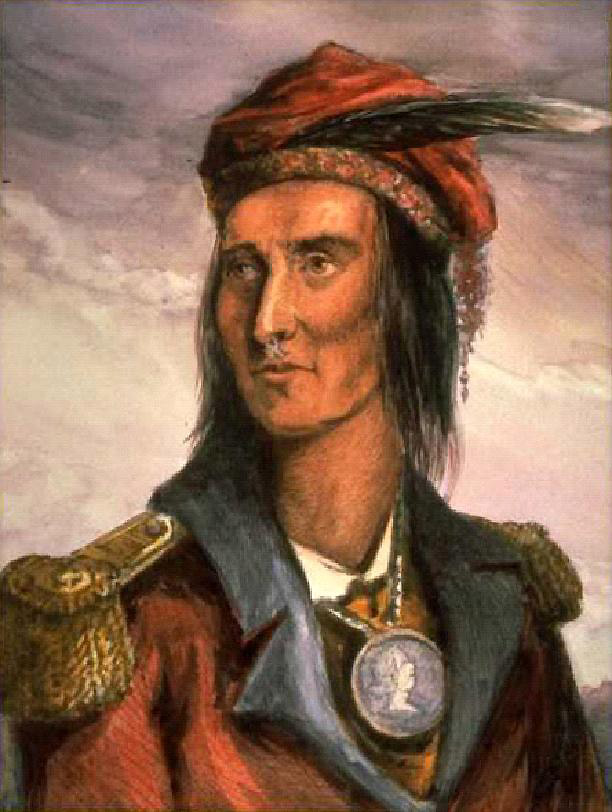
A version of Benson John Lossing's engraving (in wood) of Shawnee chief Tecumseh
Following Washington’s precedent, Jefferson made it clear in mid-1808 that he would not be a candidate for a third term. With Jefferson’s approval, the Republicans chose James Madison as their candidate for president. The Federalists nominated Charles Pinckney and hoped that anger over the embargo would help their party. Pinckney carried most of New England, but the Federalist ticket collected little support from the other regions. Madison won with 122 electoral votes to Pinckney’s 47 votes. However, Madison took office with many issues to worry about on the frontier and in foreign affairs.
While Madison was trying to decide how to resolve the difficulties with European powers, news arrived about problems in the West. Ohio had become a state in 1803. Between 1801 and 1810, white settlers continued to press for more land in the Ohio Valley. Native Americans had given up many millions of acres. Now the settlers were moving onto lands that had been guaranteed to Native Americans by treaty. As tensions increased, some Native Americans began renewing their contacts with British agents and fur traders in Canada. Others pursued a new strategy. A powerful Shawnee chief named Tecumseh built a confederacy among Native American nations in the Northwest. Tecumseh believed that a strong alliance, with the backing of the British in Canada, could put a halt to white movement onto Native American lands.
A commanding speaker, Tecumseh possessed great political skills. In his view, the United States government’s treaties with separate Native American nations were worthless. “The Great Spirit gave this great island to his red children,” he said. No one nation had the right to give it away. Tecumseh had a powerful ally, his brother, known as the Prophet. The Prophet urged Native Americans everywhere to return to the customs of their ancestors. They should, he said, give up practices learned from the white invaders: wearing western dress, using plows and firearms, and especially drinking alcohol. The Prophet attracted a huge following among Native Americans. He founded a village at a site in northern Indiana, near present-day Lafayette, where the Tippecanoe and Wabash Rivers meet. It was called Prophetstown.
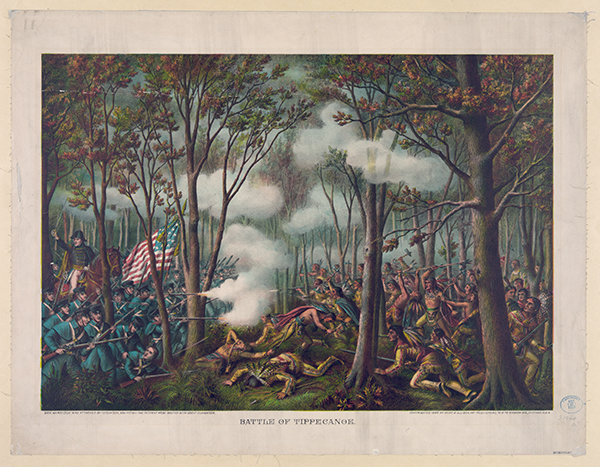
This print shows American troops under the leadership of General William Henry Harrison fighting the Native American forces of The Prophet, Tenskwatawa (the brother of Tecumseh), in a forest. Tenskwatawa was part of Tecumseh's Native American confederation.
The American governor of the Indiana Territory, General William Henry Harrison, became alarmed by the growing power of the two Shawnee brothers. He feared they would form an alliance with the British. In a letter to Tecumseh, Harrison warned that the United States had many more warriors than all the Indian nations could put together. “Do not think that the redcoats can protect you; they are not able to protect themselves.” Tecumseh sent word that he would reply in person.
A few weeks later, Tecumseh came to Harrison and spoke to the white people assembled there: “Brothers: Since the peace was made, you have killed some of the Shawnees, Winnebagoes, Delawares, and Miamis, and you have taken our land from us; and I do not see how we can remain at peace if you continue to do so. You try to force the red people to do some injury; it is you who are pushing them on to do mischief. You try to keep the tribes apart and make distinctions among them. You wish to prevent the Indians from uniting.”
In 1811, while Tecumseh was in the South trying to expand his confederacy, Harrison decided to attack Prophetstown on the Tippecanoe River. After more than two hours of battle, the Prophet’s forces fled the area in defeat. The Battle of Tippecanoe was proclaimed a glorious victory for the Americans. Harrison acquired the nickname “Tippecanoe” and used it as a patriotic rallying cry when he ran for president in 1840. Harrison’s victory at the Battle of Tippecanoe, however, resulted in something the American people had hoped to prevent. Tecumseh now joined forces with the British troops. White settlers in the region claimed that the British had supplied Tecumseh’s confederacy with guns. As a result, the rallying cry of the settlers became “On to Canada!”
| What were Native Americans who chose to adopt some Euro-American ways known as? | accommodationists |
| Which of the two Shawnee brothers was also known as the "Prophet" because he used traditional Native American beliefs with new warrior techniques? | Tenskwatawa |
| What town was founded by the Native American brothers in 1808 where they built a strong alliance that directly challenged the U.S. government? | Prophetstown |
| In which battle was Tecumseh finally killed? | Battle of Thames in 1813 |
