Nasty political mud-slinging. Campaign attacks and counterattacks. Personal insults. Outrageous newspaper invective. Dire predictions of warfare and national collapse. Innovative new forms of politicking capitalizing on a growing technology. As much as this seems to describe our present-day presidential contests, it actually describes an election more than two hundred years ago.
Question
Which election was the introduction describing?
It describes the election of 1800 between Thomas Jefferson and John Adams.
Read the following information about the election of 1800. Then answer the questions below.
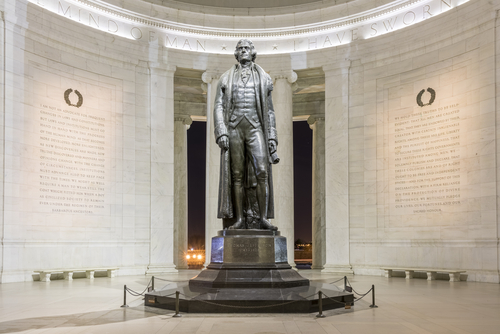
The Jefferson Memorial in Washington, D.C.
The Federalist and Republican parties fought a tough election campaign in 1800. Federalists supported Adams for a second term and Charles Pinckney of South Carolina for vice president. Republicans nominated Thomas Jefferson for president and Aaron Burr of New York as his running mate. However, at the time, electors voted for each presidential and vice-presidential candidate individually rather than voting for a party’s candidates as a team. This meant that vice-presidential candidates were in the mix to be president, too, and the top two winners would be president and vice-president.
The election campaign of 1800 differed greatly from campaigns of today. Neither Adams nor Jefferson traveled around the country making speeches about why he should be elected. That would have been considered in bad taste. Instead, the candidates and their allies wrote hundreds of letters to leading citizens and friendly newspapers to publicize their views. The letter-writing campaign, however, was not polite. Federalists charged Jefferson, who believed in freedom of religion, as being “godless.” Republicans warned that the Federalists would bring back monarchy. Federalists, they claimed, represented the interests of wealthy people with property.
When members of the Electoral College voted, Jefferson and Burr each received 73 votes. Adams was eliminated completely. Because of this tie, the House of Representatives had to decide the election. In the House, Federalists saw a chance to prevent the election of Jefferson by supporting Burr. For 35 ballots, the election remained tied. Finally, at Alexander Hamilton’s urging, one Federalist decided not to vote for Burr. Jefferson became president, and Burr became vice president. To prevent another showdown between a presidential and a vice-presidential candidate, Congress passed the Twelfth Amendment to the Constitution in 1803. This amendment, ratified in 1804, requires electors to vote for the president and vice president on separate ballots.
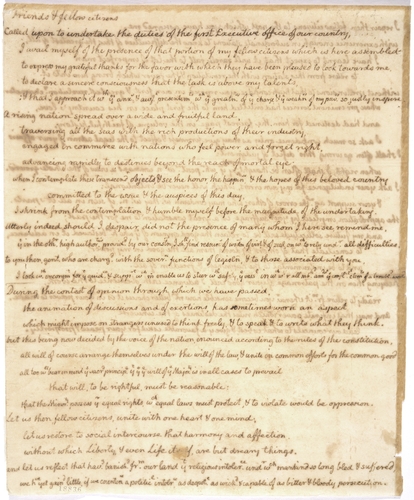
Thomas Jefferson's inaugural address of March 4, 1801
On March 4, 1801, the day of the inauguration, Jefferson dressed in everyday clothes. He left his boardinghouse and walked to the Senate to be sworn in as president. Adams did not attend the ceremony. He had slipped out of the presidential mansion and left the city so he would not have to watch Jefferson become president, which only showed the bitterness that had replaced a close friendship. In his Inaugural Address, Jefferson tried to bridge the gap between the developing political parties and reach out to Federalists with healing words. Then, he outlined some of his goals, which included “a wise and frugal government” and “the support of state governments in all their rights.” Jefferson had long been a supporter of states’ rights. He believed that a large federal government threatened liberty and that vigilant states could best protect freedom. Jefferson believed in reducing the power and size of the federal government. These ideas were like the French philosophy of laissez-faire, which means “let (people) do (as they choose).”
When Jefferson entered office, he surrounded himself with men who shared his Republican principles. His secretary of state was his friend and fellow Virginian, James Madison. For secretary of the treasury, he chose Albert Gallatin. This Pennsylvanian had a grasp of financial matters that equaled Alexander Hamilton. The new government soon ended two unpopular Federalist measures. It allowed the Alien and Sedition acts to expire and repealed the Naturalization Act. For Republicans, both acts were symbols of a federal government that threatened individual liberties.
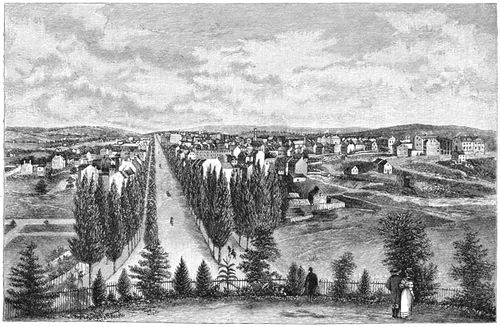
Washington, D.C., in 1800; image by unknown artist from Harper's Monthly Magazine, March 1884
Jefferson had strong ideas about how to make the United States a success. He believed that the strength of the United States was its independent farmers. If most people owned their own property, they would fight to protect their rights and to preserve the republic. For this reason, Jefferson favored expanding the nation westward to acquire more land. He also believed the federal government should be kept small. He distrusted standing armies and wanted to reduce the size of the military.
The United States government moved to the new capital city of Washington, D.C., in 1800. Being located along the Potomac River, Washington was expected to emerge as a great trading city. However, growth was so slow that many thought the government should move to a larger city. Instead of trade, the driving force of the city’s economy has become the federal government.
Jefferson and Gallatin aimed to reduce the national debt that the Federalists had left. They scaled down military expenses. They cut the army by one-third and reduced the navy from 25 to 7 ships. By slashing spending Jefferson and Gallatin significantly lowered the national debt within a few years. Jefferson and Gallatin also persuaded Congress to repeal all federal internal taxes, including the hated whiskey tax. At that point, government funds would come only from customs duties, taxes on foreign imported goods, and from the sale of western lands.
The entire federal government in 1801 consisted of only a few hundred people. This was exactly how Jefferson thought it should be. In his view, the responsibilities of the national government should be limited to delivering the mail, collecting customs duties, and conducting a census every 10 years.
| What was the aim of the Democratic-Republican party? | to limit the power of the federal government |
| Who was Thomas Jefferson's running mate in the election of 1800? | Aaron Burr |
| Why was the election of 1800 so significant? | It was the first peaceful transition of power between two opposing political parties. |
