Any book or film about World War II will mention the use of the atomic bomb by Allied Forces. However, historical documents may differ in how they present the significance of the event. One of the best ways to figure out what importance a text gives an event is to look for language that shows causes and effects.
The passage below, from a middle school history course, describes the sequence of events that occurred at the end of World War II. The key events are all there, but the text does little to explain cause-and-effect relationships between the events.
The passage below, from a middle school history course, describes the sequence of events that occurred at the end of World War II. The key events are all there, but the text does little to explain cause-and-effect relationships between the events.
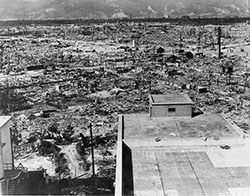 By 1942, sixty countries on six continents were at war. The Allied Powers eventually won the war in Europe, but the war in Japan continued. The U.S. decided to use the atomic bomb in hopes it would end the war. In 1945, Americans dropped the first atomic bomb on Hiroshima, a Japanese city. At least 80,000 people were killed by that blast, and two thirds of the city was destroyed. Still, Japan did not surrender. Three days later, the Americans dropped a second atomic bomb on Nagasaki, killing 40,000 people. This time Emperor Hirohito urged the military generals to surrender, saying, “I cannot bear to see my innocent people suffer any longer.” The Japanese knew they could not win the war, and they surrendered.
Question
What words or phrases are missing from this passage that would suggest more strongly that one event caused another?
words like because or since and phrases like as a result or in response to
This bit of script from a documentary about the atomic bomb is more direct about some of the long-term effects of using the bomb. It describes the effect of the Manhattan Project (the code name for the effort by scientists to build an atomic weapon) on the relationship between science and government.
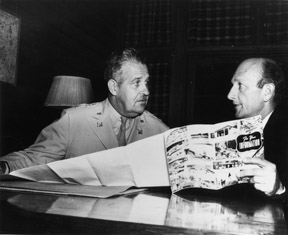 Einstein and Szilard, who set out to urge the U.S. government to be the first to build a nuclear weapon, had changed America forever. Unwittingly, their efforts ushered in an era in which scientists and their discoveries became the tools of government. The atomic bomb project was a transformative moment in the history of all science. To spend billions of dollars building a project of this scale—it gave physicists and the government a sense of the power of science in a way that was entirely unprecedented.
Einstein and Szilard, who set out to urge the U.S. government to be the first to build a nuclear weapon, had changed America forever. Unwittingly, their efforts ushered in an era in which scientists and their discoveries became the tools of government. The atomic bomb project was a transformative moment in the history of all science. To spend billions of dollars building a project of this scale—it gave physicists and the government a sense of the power of science in a way that was entirely unprecedented.
Question
What long-term effect is described in this paragraph?
Governments realized that science could be used very effectively to wage war, which meant they were likely to fund more projects like the one that built the atomic bomb.
