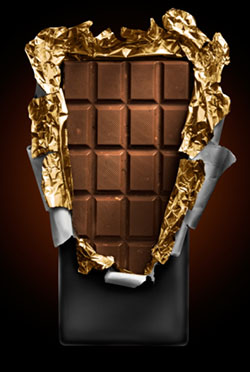
 History of Chocolate
It started in what today is southern Mexico. In the early 1500s, the Aztec emperor Montezuma supposedly drank over fifty goblets a day of chocolatl, a beverage made of ground roasted cocoa beans, water, and spices. When the Spanish explorer Cortes went to Mexico, he met with Montezuma and was offered a chocolatl. (Cortes later attacked Montezuma and destroyed his empire.) Cortes liked the taste of chocolate so much that he brought it back to Spain, where it became the drink of royalty. The Spanish liked it so much that they kept it to themselves for almost one hundred years, but you couldn't keep something like that a secret forever. And so chocolate slowly spread across Europe, where it was consumed as a beverage for the next several hundred years.
In 1828, Dutch chocolate maker C.J. Van Houten invented a chocolate press that would revolutionize the industry. Van Houten's machine pressed about half of the naturally occurring fat out of the roasted cocoa bean. This resulted in a drier cake that could be pulverized into a fine powder and mixed more easily with additional cocoa butter to achieve a certain smooth consistency. Van Houten's chocolate, just like the chocolate produced now, could be poured into molds and solidified into bars for the first time. The rest is sweet history.
Question
What kind of historical information does this wrapper give you about chocolate?
