Folded mountains are distinguished by large-scale folding patterns, caused by compression and uplifting of stratified rocks.
The best way to envision a folded formation is to imagine what happens when you push a carpet lying on a floor up against a wall. Since it can't move the wall, the carpet begins to fold in a sequence of bumps and forms ridges and valleys. In the same way, folded mountains display sequences of straight, parallel valleys and ridges. The valleys are carved out of the softer rocks, and the more resistant rocks remain as ridges. In Glacier National Park, the mountain-building process began around 60 million years ago. Tectonic pressure pushed together, folded, and fractured layers of sedimentary rock. Then, erosion processes helped shape the folded layers. The Appalachian Mountains in the eastern United States were also formed in this way.
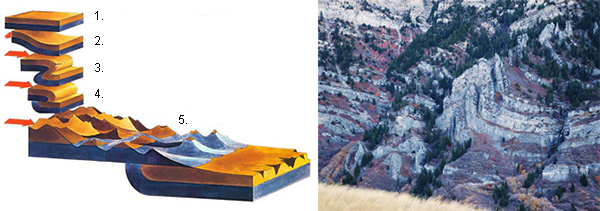
The formation of a folded mountain is described below and illustrated above.
| 1. | Over 60 million year ago, Glacier National Park contained layers of sedimentary rock. |
| 2. | Lateral (sideways) pressure from plate tectonic movement begins forcing rock layers to buckle. |
| 3. | The lateral pressure creates a fold, which eventually starts to break at stress points. |
| 4. | Once the break at the stress points is complete, the top rock layer west of the fault slides east over the bottom layer of the fold. |
| 5. | The process of erosion over millions of years wears away the sedimentary rock to form the features that are present today. |
