If you send a current through a conductor and place compasses around that wire, the needles of the compasses will show a circular path around that wire. The magnetic field produced by the wire forms concentric circles around the wire. If you switch the direction of the current flow, the compass needles will flip to point in the opposite direction. This indicates that the direction of the current flow impacts the direction of the magnetic field.
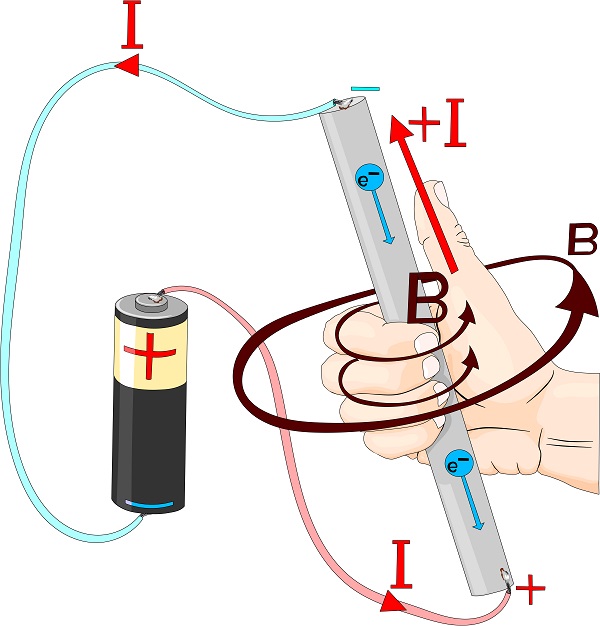
To determine the direction of the magnetic field, scientists established the right-hand rule for a current-carrying conductor. It says that if you make a fist around the wire such that your thumb points in the direction of the current, the direction of the wrapped fingers indicates the direction of the magnetic field around the wire.
Question
Do you notice anything strange about the image above?
Notice the direction of the current moves from the positive terminal to the negative terminal. This is by convention because the direction is determined by how a "positive" charge would move; however, we know that positive charges are not actually moving. Because the charges that are actually moving are electrons (negative charge), they move from the negative terminal to the positive terminal. Kind of strange, but that's how scientists defined it, though the "flow" is actually moving in the opposite direction as the direction that by convention dictates.
Question
Using vectors gives you two dimensions. How would you denote something going "into the page" or "out of the page" in note-taking or diagramming?
Convention tells us to use an X to denote something going into the page. For something coming out of the page, use an open circle O.
