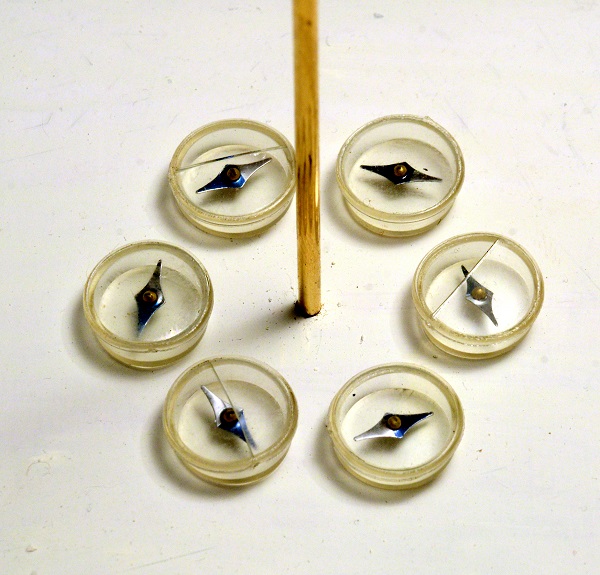
Hans Christian Oersted was a German physicist and philosopher. With Allessandro Volta's creation of the battery, Oersted launched into his studies of the new science in 1801. He spent much of his time studying the idea that all of nature was unified, and that there was some sort of law that unified all aspects of nature. He began to search for ways that electricity and magnetism were related.
Our physics would thus be no longer a collection of fragments on motion, on heat, on air, on light, on electricity, on magnetism, and who knows what else, but we would include the whole universe in one system.
—Hans Christian Oersted, Materialen zu einer Chemie des Neunzehnten Jahrhunderts, 1803
In a lecture in 1820, Oersted wanted to show his university students that electricity and magnetism were linked. He passed an electric current through a wire and placed a compass up next to the wire. The compass needle was deflected from north, showing that there was some magnetic field produced by the current in the wire. After more experimentation, he deduced that the current carrying wire produced a circular magnetic field around that wire.
Question
Did you know that Hans Christian Oersted was awarded the Copley Medal?
He was awarded the medal in 1820. It was the highest prize in science at the time, and it was granted for his discovery of electromagnetism.
