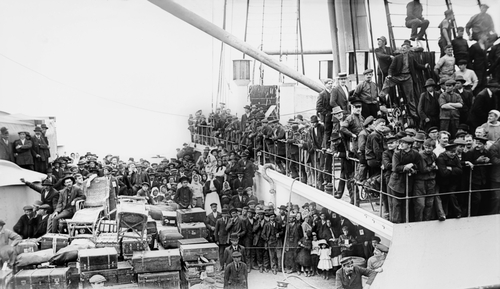
Even though the 1920s in America was seen as a progressive age, there was still much intolerance of minorities throughout the country. American nativists tried to keep out the waves of immigrants coming to America from Eastern Europe. Many felt the immigrants were taking American jobs because they worked for lower wages. Some religious fundamentalists worried as the numbers of Jewish and Catholic Americans grew larger. Legislation in the form of the National Origins Act capped the number of immigrants--particularly from "undesirable" countries--from pouring into the United States.
Not only was intolerance against immigrants common, but people were intolerant towards African Americans, too. The Ku Klux Klan was on the rise, as was violence and hate crimes. This resurgence of hate in America prompted the "Back-to-Africa" movement by Marcus Garvey who urged African Americans to leave the country.
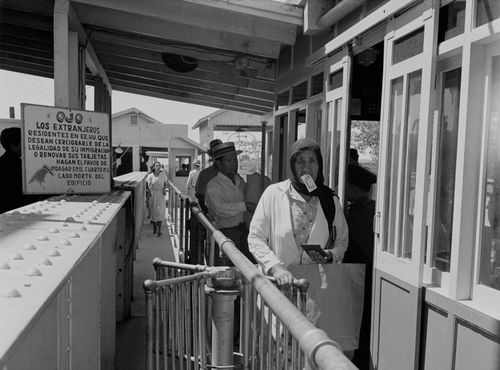
This 1938 photograph by Dorothea Lange shows Mexicans entering the United States at the immigration station at El Paso, Texas. Mexicans routinely crossed the Rio Grande to work, shop, and sometimes to stay.
The anxieties many native-born Americans felt about the rapid changes in society contributed to an upsurge of nativism, the belief that native-born Americans are better than foreigners. With this renewed nativism came a revival of the Ku Klux Klan. The first Klan had been founded in the 1860s in the South to control newly freed African Americans using threats and violence. The second Klan, organized in 1915, still preyed on African Americans, but it had other targets as well: Catholics, Jews, immigrants, and other groups believed to represent “un-American” values.
In the 1920s, the new Klan spread from the South to other areas of the country, gaining considerable power in such states as Indiana and Oregon and in many large cities. For the most part, the Klan used pressure and scare tactics to get its way, but sometimes Klan members whipped or lynched people or burned property. The Klan began to decline in the late 1920s, however, largely because of scandals and power struggles involving Klan leaders. Membership shrank, and politicians who had been supported by the Klan were voted out of office.
The concerns of the Red Scare days had not completely disappeared. Some Americans feared foreign radicals would overthrow the government. Others believed foreigners would take away their jobs. This anti-immigrant prejudice was directed mainly at southern and eastern Europeans and Asians.
In 1921, Congress responded to nativist fears by passing the Emergency Quota Act. This law established a quota system, an arrangement placing a limit on the number of immigrants from each country. According to the act, only 3 percent of the total number of people in any national group already living in the United States would be admitted during a single year. Because there had been fewer immigrants from southern and eastern Europe than from northern and western Europe at that time, the law favored northern and western European immigrants.
Congress revised the immigration law in 1924. The National Origins Act reduced the annual country quota from 3 to 2 percent and based it on the census of 1890, when even fewer people from southern or eastern Europe lived in America. The law excluded Japanese immigrants completely. An earlier law, passed in 1890, had already excluded the Chinese. These quota laws did not apply to countries in the Western Hemisphere. As a result, immigration of Canadians and Mexicans increased. By 1930, more than one million Mexicans had come to live in the United States.
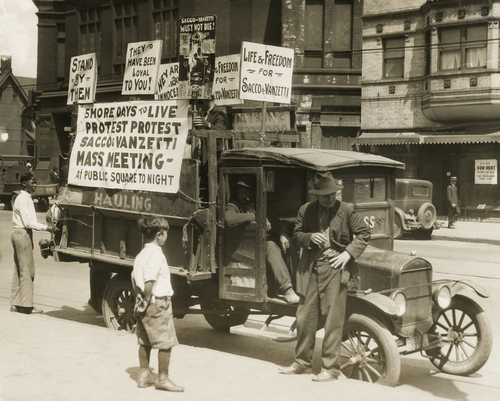
A truck with several protest signs five days prior to the executions of Sacco and Vanzetti
Fear of immigrants and radical ideas surfaced in a criminal case in Massachusetts in 1920. Two men robbed a shoe factory in South Braintree, Massachusetts, shooting and killing a guard and paymaster. Soon afterward the police arrested Italian immigrants Nicola Sacco and Bartolomeo Vanzetti for the crime. The two men were tried and convicted in July 1921 and were sentenced to death.
The Sacco and Vanzetti case created a furor. Neither man had a criminal record. Both men were anarchists, and Sacco owned a pistol like the murder weapon. Future Supreme Court justice Felix Frankfurter wrote a defense of the two men. Chief Justice William Howard Taft attacked Frankfurter for “vicious propaganda.” Many Americans demanded that the death sentence be carried out. In 1927, a special commission appointed by the governor of Massachusetts upheld the verdict. Sacco and Vanzetti, proclaiming their innocence, were executed. While historians continue to debate the verdict, the case suggested the depth of feelings against foreigners and radicals in the United States in the 1920s.
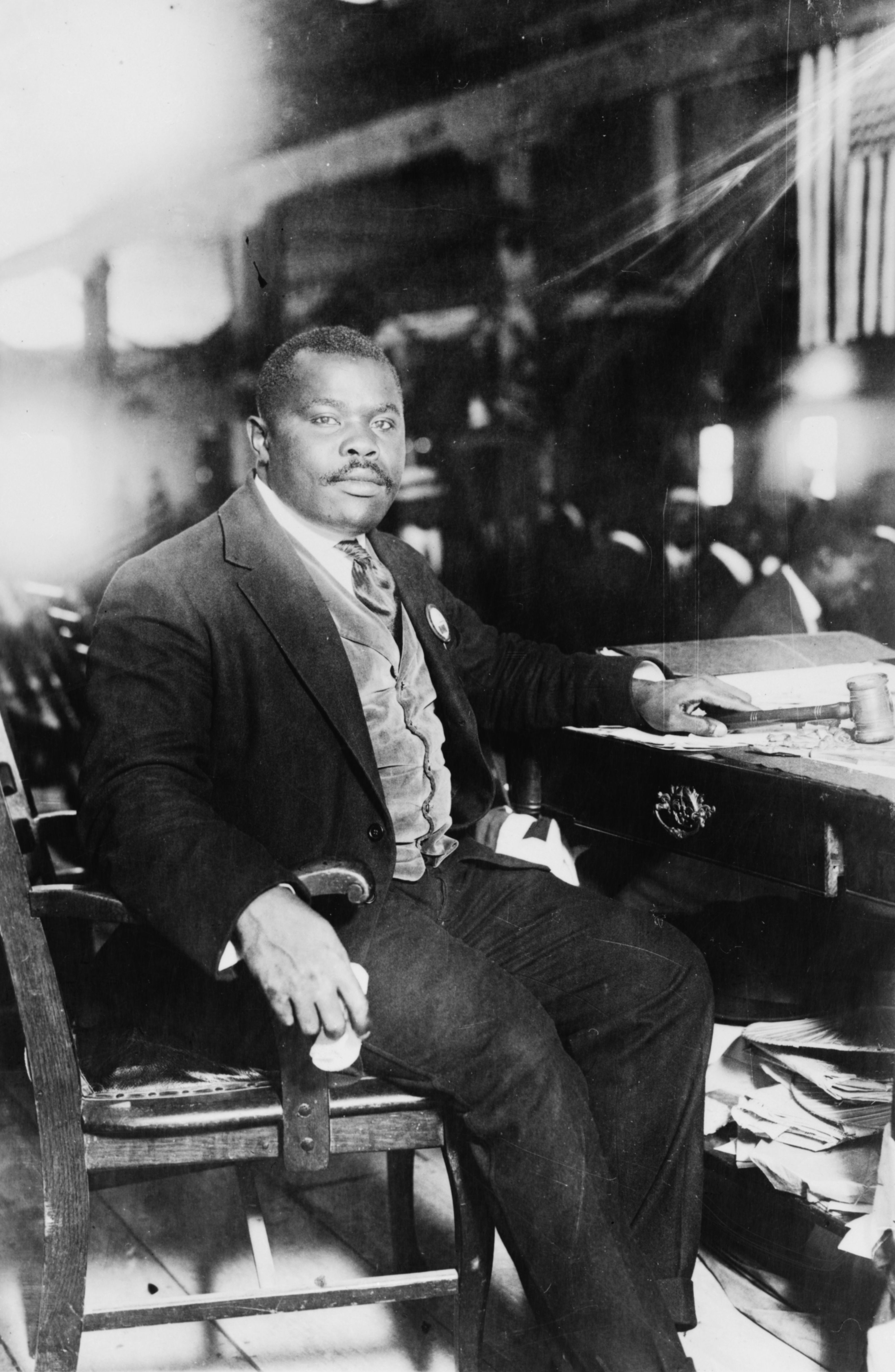
A 1924 photo of Marcus Garvey
During World War I, more than 500,000 African Americans had left the South for new jobs in the North. Many Northern whites resented African American competition for jobs. In 1919, rising racial tensions led to violence. In the South, more than 70 African Americans were lynched. In Chicago, a violent riot broke out after a group of whites stoned an African American youth who was swimming in Lake Michigan. The youth drowned, and the incident set off rioting. For two weeks, African American and white gangs roamed city streets, attacking each other, and burning buildings. The riot left 15 whites and 23 African Americans dead and more than 500 people injured.
Many African Americans turned to Marcus Garvey for answers. Garvey was born to a poor family in Jamaica, the youngest of 11 children. Educated as a journalist and filled with ambition, Garvey arrived in New York City at the age of 28. A powerful leader with a magnetic personality, Garvey opposed integration. Instead, he supported a “back-to-Africa” movement, urging African Americans to establish their own country in Africa. Garvey founded the Universal Negro Improvement Association (UNIA) in 1914 to promote racial unity and pride. During the 1920s, Garvey gained an enormous following and great influence, especially among the urban poor. With branches in many states, the UNIA organized rallies and parades to build pride and confidence among African Americans. It helped African Americans start businesses.
| What was passed in 1924 that based admission to the country on nationality? | National Origins Act |
| Where did William Simmons summon a secret meeting to revive the Ku Klux Klan? | Stone Mountain |
| What did Marcus Garvey form to promote economic cooperation among black businessmen? | United Negro Improvement Association |
