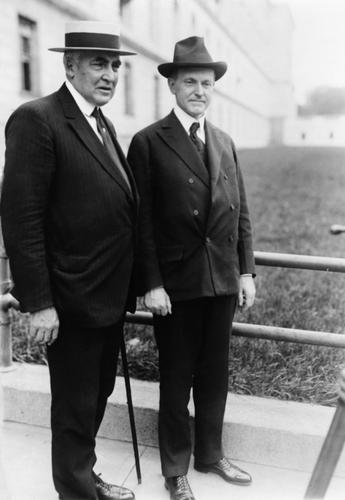
Politics in the 1920s was much different than the progressive presidencies of the previous years. Presidents Warren G. Harding, Calvin Coolidge, and Herbert Hoover took on a more laissez-faire approach to ruling. A laissez-faire political approach opposed the government regulating or interfering in commerce beyond the minimum necessary for a free-enterprise system to operate according to its own economic laws. This would ultimately lead to the stock market crash in 1929.
Warren G. Harding campaigned on the platform "A return to normalcy." This slogan appealed to people who were wishing to return to a normal life after the turmoil of World War I. Yet America was anything but normal. Flappers, jazz, and speakeasies dominated the culture. As a result of Harding's political views, corruption, fraud, and bribery marked his presidency.
Calvin Coolidge sought significant gains in international politics and worked with other nations to prevent wars from taking place in the future. A dozen years after Coolidge left office, the world was at war again.
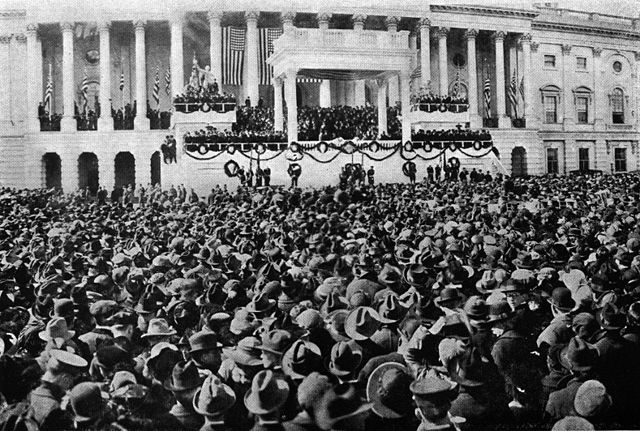
The presidential inauguration of Warren G. Harding on March 4, 1921; image from Robert Shackleton's The Book of Washington, copyright November, 1 1922.
In the summer of 1920, the Republicans gathered in Chicago to nominate a candidate for president. Although confident of victory in the upcoming election, they had no outstanding leaders to head the party ticket. So, party bosses chose “the best of the second raters” as their presidential candidate, Senator Warren G. Harding of Ohio. Harding had earned a reputation as a loyal Republican, and Ohio political boss Harry Daugherty pushed through his nomination.
Sensing Americans’ longing for calm and stability after decades of progressive reform and world war, Harding declared in his campaign that “America’s present need is not heroics, but healing.” He promised a return to “normalcy.” What Harding meant by “normalcy” was not clear, but the word sounded reassuring to those Americans who wanted an end to foreign involvement and domestic turmoil. As Harding’s running mate, the Republicans nominated Massachusetts governor Calvin Coolidge, who was recognized for his firm stand in the Boston police strike. The Harding-Coolidge ticket won a landslide victory in November 1920, the first presidential election in which women could vote. The Republicans defeated the Democratic candidate, Governor James Cox of Ohio, and his young running mate, Franklin Delano Roosevelt of New York. The Republicans also made large gains in Congress.
Harding admitted having doubts about his qualifications for the presidency. He reportedly told a friend, “I knew that this job would be too much for me.” He tried to compensate by appointing several talented people to the cabinet: Charles Evans Hughes, a former Supreme Court justice, as Secretary of State; Andrew Mellon, a prominent Pittsburgh banker and financier, to head the Treasury Department; and Herbert Hoover, a talented organizer, as Secretary of Commerce.

William "Billy" Burns testifies before the Senate committee investigating the Teapot Dome scandal on April 4, 1924. A few days earlier, President Calvin Coolidge had demanded his resignation.
President Harding also gave jobs in government to many of his friends and political supporters—the so-called Ohio Gang. He appointed Harry Daugherty as Attorney General. He named Senator Albert Fall of New Mexico, a close friend, Secretary of the Interior. Charles Forbes, another friend, became head of the Veterans Bureau. Other friends of Harding filled offices throughout the administration. Many of these appointees were unqualified, but some turned out to be corrupt. By 1922, Washington buzzed with rumors of scandals within the Harding administration. Forbes, convicted of stealing funds from the Veterans Bureau, fled to avoid imprisonment. Daugherty was accused of receiving bribes but refused to resign.
The biggest scandal of the Harding administration involved Albert Fall. In 1922, Fall secretly leased, or rented, government oil reserves in Elk Hills, California, and Teapot Dome, Wyoming, to the owners of two oil companies. In exchange, Fall received more than $400,000. After the scandal became public, Fall was convicted of bribery and sent to prison, becoming the first cabinet officer ever to go to jail. Teapot Dome became a symbol of the corruption in the Harding administration and of government corruption and scandal in general.
Harding himself was not directly involved in any scandals, but as the rumors spread, he grew increasingly distressed. “I have no trouble with my enemies,” he said. “But my friends... they’re the ones that keep me walking the floor nights!” In the summer of 1923, before the full story of the scandals came out, Harding escaped the stresses of Washington, D.C., by taking a trip west. During the trip, he became ill, suffered a heart attack, and died. Vice President Calvin Coolidge was visiting his father in Vermont when he was awakened in the early morning hours of August 3, 1923, with the news of Harding’s death. Coolidge’s father, a justice of the peace, administered the presidential oath of office. Then, the new president calmly turned off the lights and went back to bed.
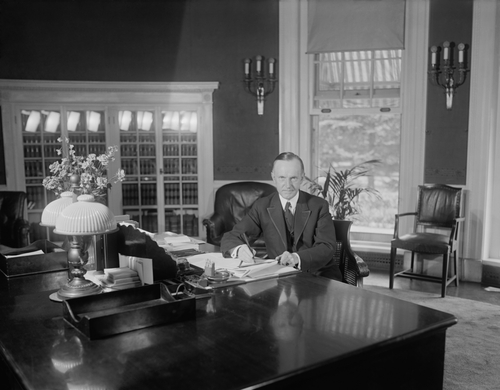
President Calvin Coolidge at the same desk used by Warren G. Harding in the Oval Office; this photo was published on Aug. 14, 1923, less than two weeks after Harding's death.
Calvin Coolidge was in many ways the opposite of Harding. While Harding loved to talk and meet people, Coolidge said very little and earned the name “Silent Cal.” In addition, Coolidge had a reputation for honesty. After becoming president, he allowed the investigations into the Harding scandals to proceed without interference. He fired Daugherty and replaced the remaining members of the Ohio Gang with honest officials. Although Coolidge and Harding differed in style, they held similar political views. Coolidge believed that the best government was the least government and that government should not interfere in the life of the nation. He once said approvingly, “If the federal government should go out of existence, the common run of the people would not detect the difference for a considerable length of time.”
Under Coolidge, the government took an active role in supporting business. Coolidge and the Republican-dominated Congress aimed to create a favorable climate for business to promote the nation’s economic prosperity. The government lowered income tax rates on the wealthiest Americans and on corporate profits and cut government spending. It also raised tariffs to protect American business and overturned laws regulating child labor and wages for women.
Coolidge seemed to be exactly what the country wanted. At the Republican national convention in 1924, the president was nominated without opposition. The Democrats took more than 100 ballots to nominate a little-known lawyer, John W. Davis of West Virginia, as their presidential candidate. Wisconsin senator Robert La Follette led a third party, the Progressives, in the race. Coolidge swept the 1924 presidential election with 54 percent of the popular vote. Other change happened, too. For the first time in America’s history, women won governors’ races: Nellie Tayloe Ross in Wyoming and Miriam Ferguson in Texas.

From November 12, 1921, to February 6, 1922, world powers met in Washington, D.C., to discuss how to avoid an arms race.
Harding and Coolidge both favored a limited role for the nation in world affairs. They desired world peace but did not want the nation to join the League of Nations or become involved in international disagreements. Harding had promised the American people that he would not lead them into the League “by the side door, back door, or cellar door.” Many Americans supported this policy of isolationism.
The Harding administration made serious efforts to promote peace. After the war the United States, Great Britain, and Japan began a naval arms race. In 1921 Secretary of State Hughes invited Japan and Britain to Washington, D.C., to discuss the problem. In February 1922, the three nations, along with France and Italy, signed the Five-Power Treaty to limit the size of the nations’ navies. The treaty marked the first time in modern history that world powers agreed to disarm. The United States continued working for peace. In August 1928, it joined 14 other nations in signing the Kellogg-Briand Pact, which called for outlawing war. Within a few years, 48 other nations had signed the pact, but it lacked any means of enforcing peace.
The United States had intervened in Latin American countries several times in the early 1900s to support American business interests. When Harding took office, American troops were stationed in Haiti, the Dominican Republic, and Nicaragua, and relations with Mexico were tense. After the Dominican Republic and Nicaragua held elections in the mid-1920s, the United States withdrew its troops from those countries. At about the same time, American investors asked Coolidge to send troops into Mexico when its government threatened to take over foreign-owned oil and mining companies. Coolidge chose to negotiate instead, and the United States reached a settlement with Mexico.
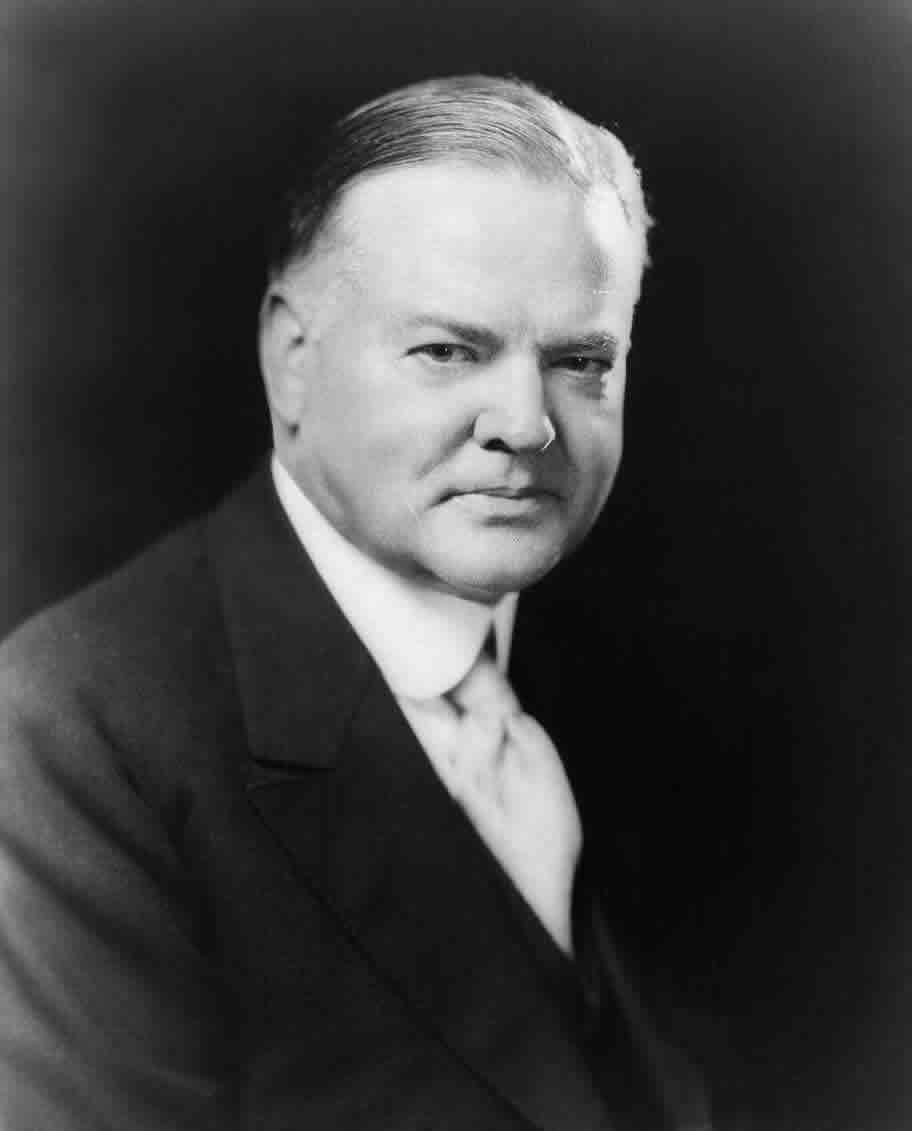
Herbert Hoover, the 31st president of the United States
In 1927, Coolidge shocked everyone by announcing that he would not run for a second full term. Herbert Hoover declared his candidacy for the Republican nomination. During World War I, Hoover had won respect as the head of a committee providing food relief for Europe. He showed such a gift in the role that “to Hooverize” came to mean “to economize, to save and share.” Later, Hoover served Presidents Harding and Coolidge as Secretary of Commerce.
Hoover worked tirelessly to promote cooperation between government and business. A symbol of the forward-looking middle class, he easily won the Republican nomination. The Democrats chose a far different kind of candidate, Alfred E. Smith, governor of New York. The son of immigrants and a man of the city, Smith opposed Prohibition and championed the poor and the working class. As the first Roman Catholic nominee for president, Smith was the target of anti-Catholic feeling.
Hoover won the election by a landslide due to both the Republican prosperity of the 1920s and the prejudice against Smith. The contest reflected many of the tensions in American society: rural versus urban life, nativism versus foreign influences, “wets” versus “drys,” Protestants versus Catholics, traditional values versus modern values.
| What exposed Harding's Secretary of Interior, Albert Fall, for accepting bribes and allowing oil companies to use public lands? | Teapot Dome Scandal |
| What pact was made in which 62 nations agreed to outlaw war? | Kellogg-Briand Pact |
| What policy allowed Germany to extend their payments of debt made to America? | the Dawes Plan |
