We've already learned a lot about how to make animations seem more convincing, lively, and fun. You know you need to make your characters appealing, use squash & stretch, slow in & out, and arcs when animating, the effect of timing, and the difference between pose-to-pose and straight ahead action. But those are only half of the insights that Disney animators Ollie Johnston and Frank Thomas introduced in their 1981 book The Illusion of Life.
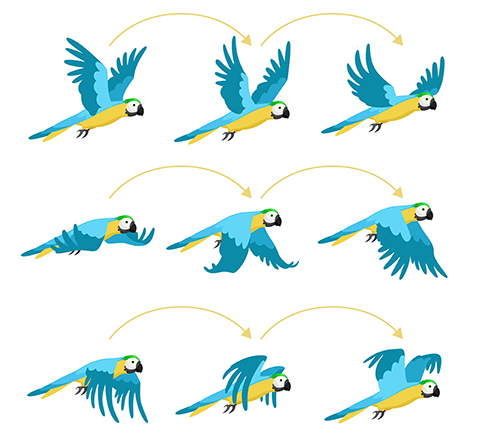
Let's continue our exploration of the 12 principles of animation and find out how to use fundamental concepts from physics, biology, and design can improve the effectiveness of our educational cartoons. Make sure to study and review these principles often!
One of the things that makes animation so fun is that you're free to amp up the intensity and expressiveness of a shot in ways that would be impossible in live action filming. If your character gets scared, you can animate their eyes popping out of their heads while their jaw drops to the floor and their skin turns white. A nervous character's heart could beat out of their chest, or their mind can literally be blown with an atomic explosion.

From Jerky Turkey by Tex Avery 1945
This kind of over-the-top exaggeration is just one way that emphasizing certain movements can make your cartoons more entertaining and imaginative. Pay close attention to your favorite cartoons, and you'll start to see exaggeration all over the place. Exaggerating action in animation is essential-- otherwise the movements look too robotic, technical, and boring.
[MUSIC PLAYING]
Watch Ravana's face closely in this clip. Look at how his mouth, tongue, and eyes detach from his face(s) to emphasize his anger and frustration. If Nina Paley had animated his expressions in a more realistic style, his fury at being defeated would have less of an impact on the audience.
When it comes to exaggeration in your animations, avoid the temptation to play it safe and keep things looking grounded and real. Instead, push your animations to the extremes of exaggeration, then dial it back a little when it starts to get too crazy. .
In animation, anticipation is when you show your character getting ready to do something before they do it. If your character is about to start running, they might lean back first, then charge ahead with all their might. If a character is about to sneeze, you might see their eyes squint shut, their face grimace, and their head pull back before the sneeze erupts in the opposite direction. Even something as simple as blinking can benefit from anticipation-- you can animate the character's eyes opening slightly right before they close to help define and emphasize the action.
 |
| When a pitcher prepares to throw a fastball, they anticipate the action by winding up first, as you can see in the first pose. |
In this scene, Nina Paley uses anticipation before each head movement as she begs her ex to take her back. This not only helps make her desperation seem more intense, it helps sell the effect of such sudden, dramatic movements and cranks up the emotion of the scene. Watch closely and you can see her head reel back before it jumps forward.
[NUMBERS DIALING]
Hello?
Please take me back. Please, please, please. I'll do anything. Please.
Whenever you're about to animate a movement, think of how you can anticipate the action beforehand. If a character is eating a donut, it's much more interesting if they open their hands and wiggle their fingers a little bit before grabbing it, instead of just picking it up.
When Walt Disney was trying to push his animators to add more realism to their drawings, he told them, "Things don't come to a stop all at once guys; first there's one part and then another." This advice eventually turned into the related concepts of follow through & overlapping action. Just like anticipation helps you predict a character's movement, follow through and overlapping action shows what happens as a result of it.
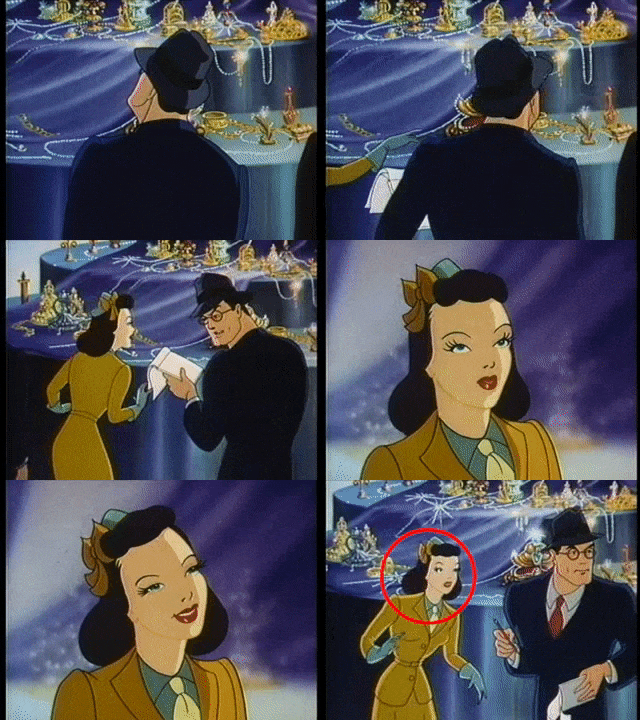
Notice how her hair and bow react to her head turns with natural follow through and overlapping action.
In Sita Sings the Blues, Paley uses overlapping action and follow through to great effect in her action scenes. When the monkey character bashes a demon on the head, his club bounces back the way it came as a response to the action.
(SINGING) The gas man, the bread man, who always collects
I hope that isn't that butter and egg man who writes out those checks
From Sita Sings the Blues by Nina Paley CC BY-SA 3.0
In your animations, think of how your characters would behave in the natural world. An elephant's trunk, for example, might swing back and forth and it walks, then keep moving for a few frames after the elephant stops.
Staging is emphasizing the part of the scene you want your audience to look at. Closely related to composition, it's the art and science of directing your viewer's attention, setting the tone of a shot, and helping to tie action scenes together.
For example, Nina Paley thoughtfully stages several different elements in the movie's intro to not only direct your eye to the most important parts, but to transition from shot to shot and character to character. As you watch the following clip, pay attention to how your eye moves around the screen as the animation evolves.
[MUSIC PLAYING]
Notice how the goddess guides our vision by first looking at us, then looking off screen to something new. When the sparkling star is revealed, we can't help but follow her gaze to this new, interesting object.
In your animations, use what you've learned about camera angles, compositions, and the basic principle of design to help control your audience's attention and manage their viewing experience.
Solid drawing means that your animated objects maintain their overall shape, proportions, mass, and weight as they move around. Even if a movement is exaggerated, your figures should look like their made of solid stuff-- that their physical properties don't just magically mutate from frame to frame.
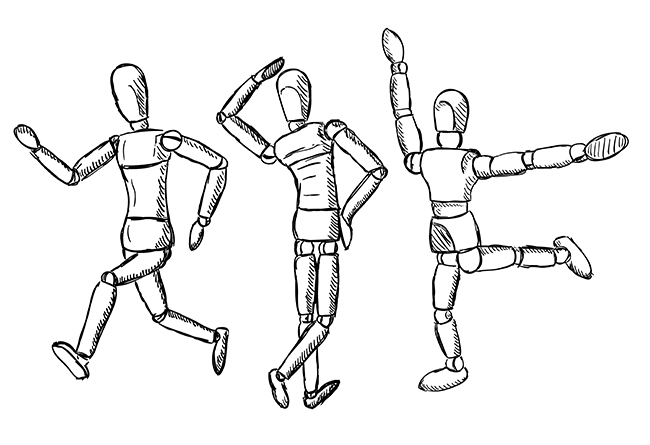
Solid drawing relies on the artist having a sound understanding of the underlying structure and composition of whatever they're animating. They have to be able to visualize the object in 3D space, and imagine how it might move or transform while staying true to its nature. For example, you might sketch the face of a character looking straight at the lens, it it would look terrific. But when you try to draw that same character from a side view, suddenly it might look weird or disproportional. This is because you need to think of each animated object as occupying real space, with parts that make sense.
(SINGING) Love me
Oh, na, na
Oh
Love me
Love me
Yeah
Love me
Me
Yeah
In this dance sequence, Nina Paley shows her skill with solid drawing. The skeleton figure moves in a fluid, anatomically sound way, showing that the artist has studied figure drawing and knows how to envision realistic movements for living things.
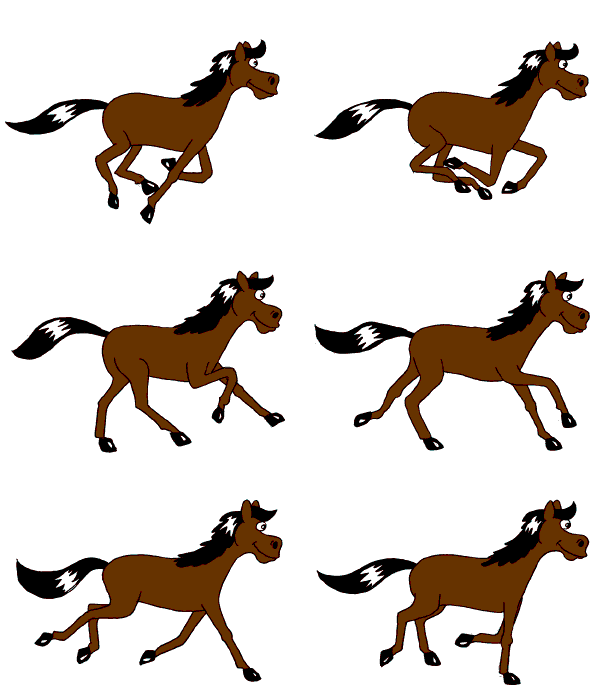
The last principle of animation we'll look into is secondary action. Secondary action is related to follow through & overlapping action, because it deals with actions that happen along with and because of other actions. For example, when a horse gallops, its hair and tail bounce around along with the movement as the primary action of the body radiates out.
Check out Paley's use of secondary action in this scene. When Rama walks all over Sita, she squashes like a rubber toy, emphasizing the action. Pay attention to the secondary action as Sita's skeleton collapses, and each little bone bounces once or twice before settling into place.
[MUSIC PLAYING]
I got on my knees
The kind of woman like me
Going to die if sweet man should pass me by
If I die, where will he be?
He's the kind of man needs a kind of woman like me
