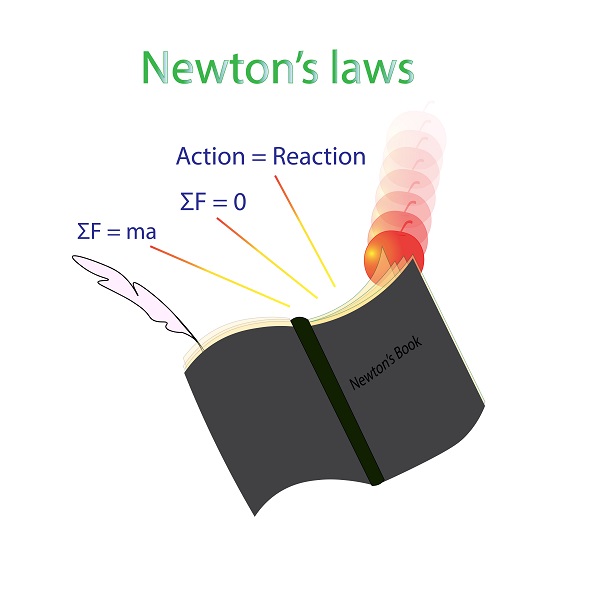
Isaac Newton was a key figure in the scientific revolution and was known as a mathematician, astronomer, and physicist. Up until the point where he explained his hypotheses (now laws) regarding motion, there was a very flawed understanding of what caused objects to stay in motion. Now, not only do we understand what causes a change in motion, we can quantify that change as well. A good understanding of these laws is essential in understanding the world around us. It also helps clarify some of the most common misconceptions people hold about the motion of objects. Can you state the laws?
Question
What is Newton's First Law of Motion?
Also known as the Law of Inertia, Newton's First Law states that an object at rest will stay at rest and an object in motion will stay in motion unless acted upon by an unbalanced force
Question
What is Newton's Second Law of Motion?
Newton's Second Law allows us to quantify acceleration. It states that the acceleration of an object is directly proportional to the net force acting on the object and inversely proportional to the object's mass.
By studying Newton's 1st and 2nd Laws, you know what causes a change in motion and how to quantify that change. But, what about the interaction between objects? The last law that we will look at it Newton's Third Law, which is about what happens to the object applying the force when that force is applied.
