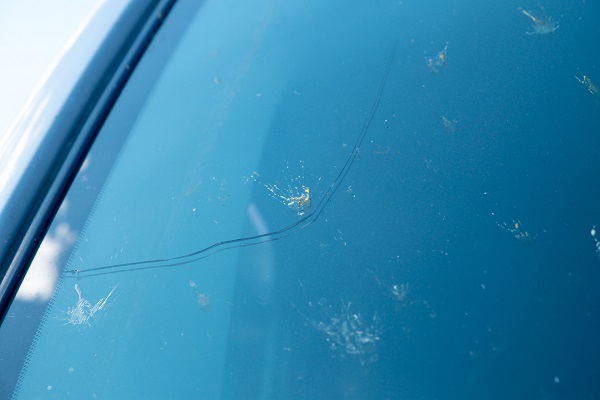
Another common misconception of Newton's Third Law is that the effect of these action-reaction pairs is the same, but that is not always the case. Consider the situation where a car hits a bug as it is driving down the road. This is an example of Newton's Third Law—there's the force of the bug on the windshield and the force of the windshield on the bug.
Question
Which of these forces is larger?
Many people would say that the force on the bug is larger than the force on the windshield because the force is definitely more detrimental to the bug; however, according to Newton's Third Law, they have the same magnitude.
Keep in mind that the force that acts on the bug acts on an a very small mass, whereas the force that acts on the car acts on a very large mass. If we then take into consideration Newton's Second Law, you can show that the acceleration of the bug is going to be much larger than the acceleration of the car.
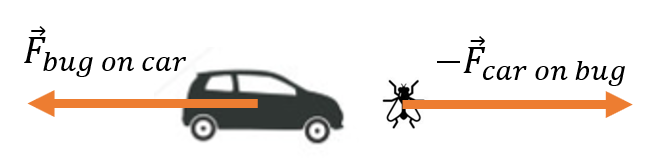
Let's say the mass of the car is 895 kg and the mass of the bug is 2.50 x 10⁻⁷ kilograms. If the force that the car applies to the bug is 2.00 N, what is the acceleration of the bug? of the car? You have to treat each separately, since the force acts on each separately (even if at the same time). In the calculations below, you can see how Newton's Second Law is written specific to each the car and the bug.
| Acceleration of the Bug | Acceleration of the Car |
|---|---|
| \(\small\mathsf{ \overrightarrow{F}_{\text{car on bug}} = 2.00 \text{ N} }\) \(\small\mathsf{ m_{bug} = 2.50 \times 10^{-7} \text{ kg} }\) \(\small\mathsf{\overrightarrow{a}_{bug} = ? \text{ m/s}^2 }\) |
\(\small\mathsf{ \overrightarrow{F}_{\text{bug on car}} = -2.00 \text{ N} }\) \(\small\mathsf{ m_{car} = 895 \text{ kg} }\) \(\small\mathsf{\overrightarrow{a}_{car} = ? \text{ m/s}^2 }\) |
| \(\small\mathsf{ \overrightarrow{F}_{\text{car on bug}} = m_{bug} \overrightarrow{a}_{bug} }\) | \(\small\mathsf{ \overrightarrow{F}_{\text{bug on car}} = m_{car} \overrightarrow{a}_{car} }\) |
| \(\small\mathsf{ 2.00 \text{ N} = (2.50 \times 10^{-7} \text{ kg}) \overrightarrow{a}_{bug} }\) \(\small\mathsf{\overrightarrow{a}_{bug} = \frac{2.00 \text{ N}}{2.50 \times 10^{-7} \text{ kg}} }\) \(\small\mathsf{\overrightarrow{a}_{bug} = 8.00 \times 10^6 \text{ m/s}^2 }\) |
\(\small\mathsf{ -2.00 \text{ N} = (895 \text{ kg}) \overrightarrow{a}_{car} }\) \(\small\mathsf{\overrightarrow{a}_{car} = \frac{-2.00 \text{ N}}{895 \text{ kg}} }\) \(\small\mathsf{\overrightarrow{a}_{car} = -2.23 \times 10^{-3} \text{ m/s}^2 }\) |
As you can see, the acceleration of the bug is much greater than the acceleration of the car. Because of this, you really cannot see the effect of the bug hitting the windshield, but you can certainly see the effect of the windshield hitting the bug.
