Two rays that share a common endpoint will form an angle. When you have three or more line segments that connect to enclose a figure, that figure is known as a polygon. The word polygon means "many angled," so it make sense that they also form multiple angles inside. Polygons can be identified by their names, and more specifically the prefixes in their names. A prefix is "a letter, a number, or a word that is placed before another." In the case of polygons, these prefixes tell us how many sides the polygon has. Let's make a chart of the prefixes that can help us name and classify polygons.
| Prefix | Definition |
| tri- | Means "three," so three-sided figures such as the triangle begin with tri-. |
| quad- | Means "four," so four-sided figures such as quadrilaterals begin with quad-. |
| penta- | Means "five," so five-sided figures are called pentagons and begin with penta-. |
| hexa- | Means "six," so six-sided figures are called hexagons and begin with hexa-. |
| hepta- | Means "seven," so seven-sided figures are called heptagons and begin with hepta-. |
| octa- | Means "eight," so eight-sided figures are called octagons and begin with octa-. |
Question
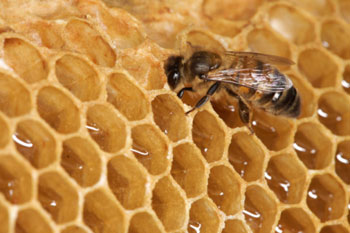
What type of polygon is in this beehive?
If you look closely you will see that the beehive is made up of many six-sided figures, all attached in a pattern. These six-sided figures are called hexagons and are just one example of polygons.
