What comes to mind when you hear the word bacteria? You may think of all the antibacterial products people use to protect against bacteria that can cause illness or infection. Our use of these products reminds us of the harm that bacteria can cause, but infection and disease are barely half of the picture. Click each of these images to learn some of the ways that bacteria can help us or harm us.
|
If you've ever had strep throat, you had a bacterial infection that was probably treated with an antibiotic. There are several serious illnesses caused by bacteria including cholera, tuberculosis, and leprosy. Antibiotics have been developed to treat many illnesses caused by bacteria. In fact, bacteria can also be used by scientists to help develop new medicines to fight diseases.
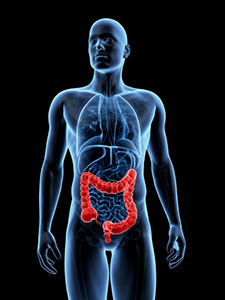
While some bacteria can harm you, there are many ways bacteria help you. In this image, you see the colon (large intestine) in red and the small intestine outlined in blue. Approximately 100 trillion microorganisms, including bacteria, live in your intestines. They help you by breaking down your food and making vitamins that your cells cannot. The bacteria in your intestines also help protect you from being infected by other bacteria that could cause illness.
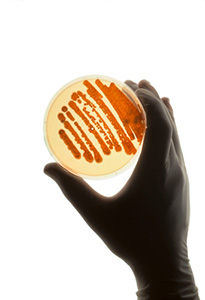
There are many ways that bacteria are used in scientific research. In this image, you see a petri dish where colonies of bacteria are growing. Plasmids are circular DNA floating in the cytoplasm in bacteria. Since they are not protected in a structure like a nucleus, it is very easy for scientists to insert DNA they want to study into the plasmids. Bacteria divide very rapidly and make many copies of the DNA the scientists want to study. This technique is very useful for studying a wide range of illnesses and for developing effective treatments for these illnesses.
This picture shows an oil slick on the sea. Because bacteria can break down organic materials in oil, they can be used to clean up oil spills. |
 |



Question
How does the prokaryotic structure of bacteria make them useful for scientific research?
