You'll learn more about archaea later in this course. For now, let's examine the prokaryotic characteristics of bacteria. Look at the bacteria cell model below. How does it compare to the eukaryotic cells you were studying earlier in the course? You may have noticed that it seems less organized or maybe it just seems a little simpler without all the organelles that eukaryotic cells have. Look at the features of this prokaryotic cell, then read more about it below.
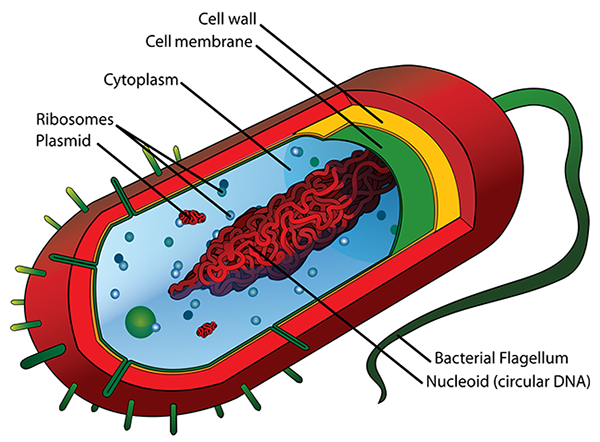
Like eukaryotic cells, this prokaryotic cell model has a cell membrane that contains the cytoplasm and regulates what materials enter and exit the cell. Similar to plants, which are eukaryotic, prokaryotic cells have a cell wall that protects the cell and provides structure.
There are also many ways prokaryotic cells are not like eukaryotic cells. The biggest difference is the way that DNA is stored in each type of cell. In the image above, you see that prokaryotic cells have a nucleoid, a complex of DNA bound to proteins. While the majority of the DNA in the cell is stored in the nucleoid, there are also smaller bits of DNA called plasmids floating free in the cytoplasm. You may recall that eukaryotic cells store DNA in a nucleus that is protected and contained by the nuclear envelope.
Like eukaryotic cells, prokaryotic cells do have ribosomes, but they are much more primitive, or simple, than eukaryotic cell ribosomes. Many prokaryotic cells also have a flagellum, a whip-like structure that is used for movement. In fact, there are several types of bacteria that have more than one flagellum. There are some eukaryotic cells that have a flagellum, but it is more common for prokaryotic cells.
Question
What is the main difference between this bacterial cell and eukaryotic cells?
