Finding Fragments
How can you tell if a sentence is broken?
Goal:
Goal:
A group of words without both a subject and a predicate is not really a sentence. It's just part of a sentence--a sentence fragment. You can identify the most common sentence fragments by asking yourself these two questions.
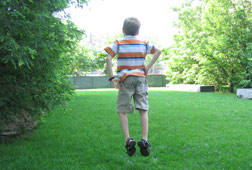 |
Is there a subject? (Is there someone or something in the sentence?) |
 |
Is there a predicate? (Is someone actually doing something in the sentence?) |
Use the activity below to practice identifying sentence fragments:
Which of these word groups is a sentence fragment (not a complete sentence)?
- The sinking ship disappeared quickly.
- The sinking ship left a lot of trash in the water.
- Leaves trash in the water.
If a word group has both a subject and a predicate, then it is a complete sentence—not a fragment.
If a word group has both a subject and a predicate, then it is a complete sentence—not a fragment.
If a word group has both a subject and a predicate, then it is a complete sentence—not a fragment.
Which of these word groups is a sentence fragment (not a complete sentence?)
- Ellen and her best friend Barry.
- Ellen and her best friend went to the carnival together.
- Ellen and Barry rode every ride.
A fragment lacks either a subject or a predicate. "Ellen and her best friend Barry" is a fragment because it contains no verb—it’s just part of sentence.
A fragment lacks either a subject or a predicate. "Ellen and her best friend Barry" is a fragment because it contains no verb—it’s just part of sentence.
A fragment lacks either a subject or a predicate. "Ellen and her best friend Barry" is a fragment because it contains no verb—it’s just part of sentence.
Which of these word groups is a complete sentence? (Only one of them is.)
- Whistling and singing in the shower.
- Not my favorite things.
- Whistling and singing are my favorite ways to annoy my sister.
A complete sentence must include a subject ("whistling and singing") and a predicate ("are my favorite ways to annoy my sister").
A complete sentence must include a subject ("whistling and singing") and a predicate ("are my favorite ways to annoy my sister").
A complete sentence must include a subject ("whistling and singing") and a predicate ("are my favorite ways to annoy my sister").
Which of these word groups is a complete sentence? (Only one of them is.)
- We left all of our food.
- Food at the campsite.
- All of our food.
A group of words that includes a subject ("We") and a predicate ("left all of our food").
A group of words that includes a subject ("We") and a predicate ("left all of our food").
A group of words that includes a subject ("We") and a predicate ("left all of our food").
Summary
 Questions answered correctly:
 Questions answered incorrectly: