Introduction
Which number is greater, which is smaller, and which decimals numbers are equal?
Goal:
Goal:
Comparing numbers with decimals can come in handy when shopping. It can also help to determine size when using precision measurements. In this video, you will learn to compare decimals.
 Compare
Decimals Video Script
Compare
Decimals Video Script
How do we compare decimals? Let’s review how to compare whole numbers first 3 and 5. We compare numbers by looking at the place value farthest to the left. Since both numbers are in the ones place we look at each digit. A number line can help us. If we circle the numbers on the number line, 3 and 5, we see that 3 is less than 5 so we write 3 ˂ 5. The arrow points to the smaller number and opens up to the bigger number.
Compare howl numbers 29 and 18. We can line the numbers underneath each other when there are multiple digits to help compare place value. Compare the place value farthest to the left first. In these numbers that would be the 2 and 1. 2 is greater than 1, so 29 ˃ 18. The open arrow faces the bigger number.
We use the same strategy when comparing decimals. Look at the numbers and compare the place value to the far left first. 7.126 and 7.835. In this example the numbers are lined up on the place value chart. The chart has the tens place and ones place before the decimal and the tenths place, hundredths place and thousandths place after the decimal. Compare the place value to the far left first. The 7’s are the same, so we go to the next place value. After the decimal there is a 1 and an 8. The 8 is larger than the 1 so 7.835 ˃ 7.126.
Compare decimals. 5.492 and 5.491. Line up the place values. Start at the far left. The 5’s are the same, so we move to the next place value. The 4’s are the same so we move to the next place value. The 9’s are the same so we move to the next place value. The 2 in the thousandths place is larger than the 1 in the thousandths place so 5.492 ˃ 5.491.
Compare decimals. Pause the video to compare numbers. Press play to check your answer. If you said 4.311 is equal to 4.311 you’re right. When we compare place values, the numbers in each place value are the same so the numbers equal each other.
Compare decimals. Pause the video to compare. Press play to check your answer. If you said .036 ˃ .0306 you’re right! When we compare place values starting at the left, the 0’s are the same, the 3’s are the same, but the 6 is larger than the 0 so .036 ˃ .0306.
Last one. Compare decimals. .9247 and .9237. Pause the video to compare. Press play to check your answer. If you said .9247 ˃ .9237 you’re right! The 9’s are the same, the 2’s are the same but the 4 is greater than the 3 so .9247 ˃ .9237.
Remember when comparing decimals to start at the place value farthest to the left, then move to the digits to the right.
The process of comparing the decimal numbers is the same process as when you compare whole numbers: Look at the place value position farthest to the left and compare the numbers that are there. Which one is bigger? If they are the same, move to the right and compare again. Continue moving to the right until one number is greater than the other OR until you find that the numbers are equal.
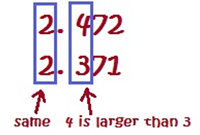
Example 1: Which is greater, 2.472 or 2.371?
Start with the ones place. They are both 2, so move to the tenths place. 2.472 has a 4 and 2.371 has a 3; 4 is larger than 3, so 2.471 is greater than 2.371.