More About Comparing Decimals
Sometimes when we look at decimals, it’s difficult to tell which decimal is larger than the other, because they don’t have the same number of digits.
Goal:
Goal:
Example 2: Which is greater, 0.4 or 0.38?
Start by comparing the place farthest to the left. In this case, both numbers have a ones place farthest left, and both have a 0 in that place; so, move to the next place. 0.4 has a 4 in the tenths place and 0.38 has a 3 in the tenths place, so 0.4 is the greater number.
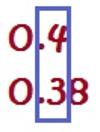
Sometimes students get fooled and think that if a number has more digits, it is the larger number. This is not always the case when you are working with decimals. Sometimes the number with more digits is larger, but sometimes it is not. You MUST compare each place before you make a decision about which number is greater. If it is helpful, you can add zeros to the right of the shorter decimal to give it the same number of decimal places as the other.
In this problem,you can add one zero to the end of 0.4 and make it 0.40. This does not change the value of 0.40 (there is still a 4 in the tenths place)— it just renames it. Now you have 0.40 and 0.38.
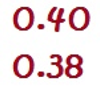
When you look at the decimal numbers in this way, as “40” and “38,” it may be a little easier to see which number is larger.