Summary and Paraphrase Assignment, Part 1
Try summarizing some informational text.
Goal:
Goal:
When you summarize, you should follow the organization of the original text (the article you're summarizing). Present the main ideas in the same order they appear in the article, and use a tone that is similar to that of the original article.
Read the article "How Do Frisbees Fly?" Then complete the first two sections of the Summary and Paraphrase Worksheet below. Your summary should be no more than one paragraph long.
How Do Frisbees Fly?
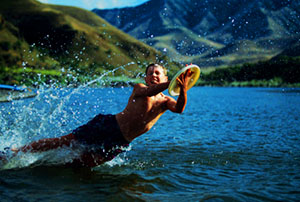 You've probably watched a Frisbee glide smoothly through the air. All Frisbees are round and mostly flat, but do they have to be shaped like that to fly? Frisbees are able to fly because they are lightweight, able to resist gravity, and stable enough to move through the air.
The first Frisbees were empty pie pans. Their shape has changed very little over the years. This is because Frisbees (and pie pans) are perfectly shaped so that they resist gravity—at least for a little while. Gravity is the force that pulls you down to Earth and keeps you from floating off into space.
Because Frisbees don't weigh much, they are able to fly more easily than heavy objects can. Think about throwing a large rock and throwing a Frisbee. Which one can you throw farther? You will be able to throw the Frisbee much farther because it weighs less. Its weight helps the Frisbee defy gravity.
When you look at a Frisbee, you will notice that it has a domed top and rounded edge. These two features cause lift. Lift is what keeps airplanes and birds flying. It is a force that pushes up against gravity. As the Frisbee flies, air hits its rounded edge and bottom first. The air above the Frisbee moves faster over its curved surface than the air below the Frisbee. The faster air has a lower pressure than the slower air. It is this pressure difference that creates lift.
If you throw a Frisbee without spinning it, it will tumble and fall to the ground. However, if you give the Frisbee a twirl when you throw it, it will fly far and wobble very little. This is because Frisbees need stability to fly. This spinning action, which stabilizes the Frisbee, is called angular momentum. You can see angular momentum when you spin a top. As long as the top is spinning, it will balance on its point. However, when the spinning slows, the top falls over. The same force keeps the Frisbee gliding, or slicing, through the air in a stable way.
Although pie pans weren't meant to be thrown around, they were the model for a very fun and interesting toy. So the next time you throw a Frisbee, think about why it is able to fly—because it is lightweight, defies gravity, and is stable in flight.
Once you have completed this activity, save the file or printout where you can find it easily. You will add more to it later in this lesson.