Language: Adjectives With Similar Meanings
https://cms.accelerate-ed.com/s3/r/content/Elementary/docs/LanguageArts1/audio/ELA1_23.2_pg5_1.mp3 It is time to learn about finding the differences in adjectives with similar meanings.
Goal:
Goal:
https://cms.accelerate-ed.com/s3/r/content/Elementary/docs/LanguageArts1/audio/ELA1_23.2_pg5_2.mp3
Work your way through the slideshow below to learn how to tell the difference between similar adjectives.
https://cms.accelerate-ed.com/s3/r/content/Elementary/docs/LanguageArts1/audio/ELA1_23.2_pg5_2_audio_1.mp3 Remember that an adjective is a word that describes a person, place, or thing. Some adjectives have similar meanings. But there can be important differences in their meanings. Understanding the differences in different adjective words can help you understand what you read, and it can make you a better writer, too. Let’s look at some adjectives that are similar but also try to figure out how they are different.
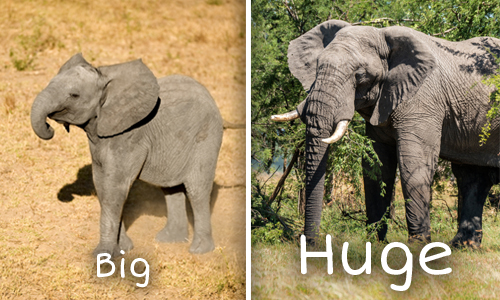
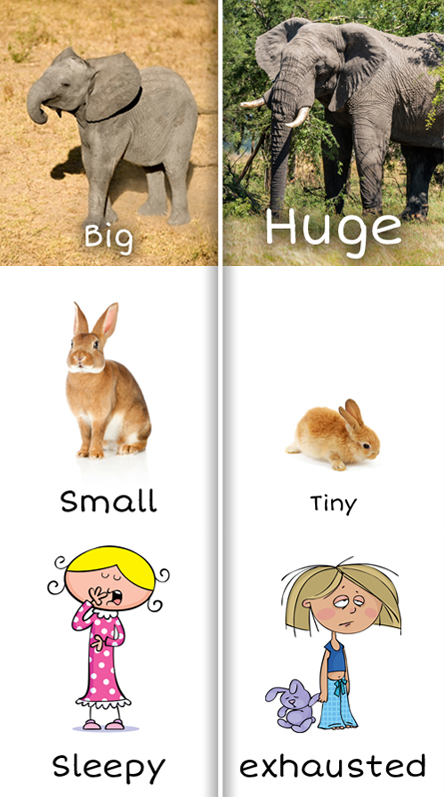
https://cms.accelerate-ed.com/s3/r/content/Elementary/docs/LanguageArts1/audio/ELA1_23.2_pg5_2_audio_2.mp3 Take a look at the words on the screen: “big” and “huge.” The adjectives big and huge describe the elephants and have similar meanings. If something is big it is a good size, or it is large. But if something is huge, that means that it is extremely large. It is bigger than big. So even though these adjectives have similar meanings, there is a bit of difference that is important. When you read these two words in stories, “big” gives you a picture in your mind of something that is a pretty large. But when you read the word “huge” in a story, it helps you picture something that is extremely large!
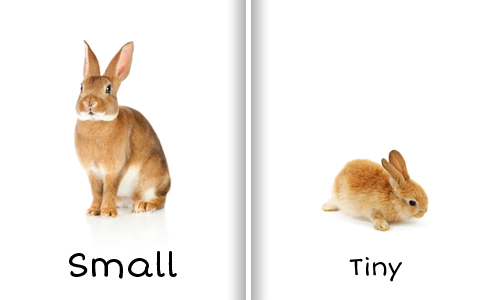
https://cms.accelerate-ed.com/s3/r/content/Elementary/docs/LanguageArts1/audio/ELA1_23.2_pg5_2_audio_3.mp3 Here are a couple of new words: small and tiny. Both of those words are adjectives that describe the size of something, and both have similar meanings. There is a difference between those two adjectives, though. “Small” means that something is not very big, and “tiny” means that something is even smaller than small. So if you wanted to describe something that was VERY small, the word tiny would be a great word to choose.
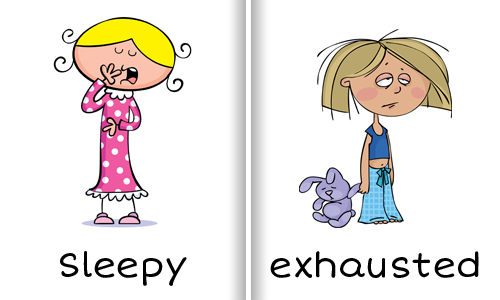
https://cms.accelerate-ed.com/s3/r/content/Elementary/docs/LanguageArts1/audio/ELA1_23.2_pg5_2_audio_4.mp3 Let’s look at one more pair of adjectives that are similar. “Sleepy” and “exhausted” both mean tired. However, being sleepy just means that you are a little tired and ready to sleep. But if you are exhausted, that means you are more than tired and past the time you should have been in bed and sleeping. It helps to know the difference between these two adjectives when you read them in stories and when you are writing.
https://cms.accelerate-ed.com/s3/r/content/Elementary/docs/LanguageArts1/audio/ELA1_23.2_pg5_2_audio_5.mp3 Great work finding the difference between adjectives that have similar meanings. Watch for these kind of words in everything you read, and think about how to use them when you are writing stories!
|
 |

https://cms.accelerate-ed.com/s3/r/content/Elementary/docs/LanguageArts1/audio/ELA1_23.2_pg5_3.mp3
Great work today!