Reading
 What will I learn about magnets today?
Goal:
Goal:
 It's time to read "Magnet Fun" today.
Yesterday, we thought about what we know about magnets and what we would like to know. Let's
see if we learn the answers to our questions!
It's time to read "Magnet Fun" today.
Yesterday, we thought about what we know about magnets and what we would like to know. Let's
see if we learn the answers to our questions!
As you read, you will see our vocabulary words highlighted in yellow.
You can read the selection on your own, or you can read along with the audio today.
Magnet Fun
by Kristen Kunkel
 They are hidden in your refrigerators, washing machines, TVs, and
computers. Do you know what they are? Do not be afraid. They are only magnets.
They are hidden in your refrigerators, washing machines, TVs, and
computers. Do you know what they are? Do not be afraid. They are only magnets.
All Shapes and Sizes
Magnets come in all shapes and sizes. They can be round or square. Some have a horseshoe shape. Some are shaped like donuts. Some magnets are tiny. Some are huge. Magnets can be painted different colors, too.
Things in Common
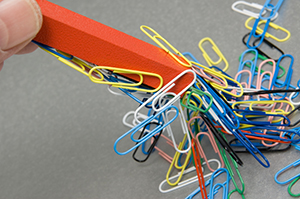 Could a magnet pick up plastic paperclips? |
Magnets are made of metal. Most magnets are made of iron or steel. Magnets can only attract an object made of iron, steel, cobalt, or nickel. That is why you can pick up paper clips and nails with a magnet. They are made of these metals. A magnet cannot pick up a toothpick. It is made of wood. It cannot pick up a plastic button. A magnet cannot pick up a wax crayon. Objects are called magnetic if a magnet can attract them.
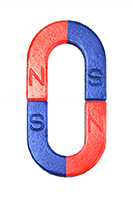 All magnets have poles, too. A pole is the place on a
magnet where the force is strongest. Magnets have a north pole and a south pole. If you have
two magnets, it is fun to observe what happens when
you put them next to each other. If you place the north pole of one magnet near the north
pole of a second magnet, the magnets will repel, or
push away. No matter how much force you apply, the same poles of two magnets will not
attract. As soon as you turn one magnet so that opposite poles are near each other, the
magnets will snap together. Opposite poles attract.
All magnets have poles, too. A pole is the place on a
magnet where the force is strongest. Magnets have a north pole and a south pole. If you have
two magnets, it is fun to observe what happens when
you put them next to each other. If you place the north pole of one magnet near the north
pole of a second magnet, the magnets will repel, or
push away. No matter how much force you apply, the same poles of two magnets will not
attract. As soon as you turn one magnet so that opposite poles are near each other, the
magnets will snap together. Opposite poles attract.
Earth Is a Magnet
Did reading about the north and south poles on a magnet make you think about Earth's North Pole and South Pole? If it did, there's a good reason. Earth is a huge magnet, and like other magnets, it has a north and a south pole. That is why a compass needle always points to the north. The needle of a compass is a magnet. The Earth's north pole attracts the compass needle.
Everyday Useful Magnets
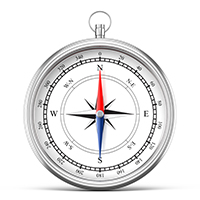 A compass is powered by magnetism. |
 Some popular toys use magnets, too. One of these toys features a blank
face and a lot of iron shavings. Clear plastic covers the face to keep the iron shavings
from falling off. To play, you shake iron shavings to scatter them. Then, you
use a magnet to pull the iron shavings onto the face to make hair. It's a lot of fun! Where
else have you seen magnets?
Some popular toys use magnets, too. One of these toys features a blank
face and a lot of iron shavings. Clear plastic covers the face to keep the iron shavings
from falling off. To play, you shake iron shavings to scatter them. Then, you
use a magnet to pull the iron shavings onto the face to make hair. It's a lot of fun! Where
else have you seen magnets?
Make Your Own Magnet
You can make a magnet, but it won't last long. You will need a magnet and something magnetic, such as a nail. Take the magnet and rub it along the magnetic object. Always rub in the same direction. Do this at least twenty times. Then, test your new magnet. Will it pick up another magnetic object? It should! See how long your magnet keeps its magnetism. Do other tests. How can you make your magnet stronger? How can you make it last longer? Send us a video of your experiment. We want to see!
The End
 Click the icon to download a PDF version of the story.