Although ancient peoples around the world developed different languages, clothing styles, religions, and art, there are certain things they all shared in common. For example, every major ancient civilization emerged close to a good source of fresh water, and each developed great trading cities. What else did ancient civilizations share?
This slide how describes four different ancient civilizations that were successful enough to produce cities. As you read each slide, fill in the Comparing Ancient Civilizations worksheet linked to the Activity button below. Then, look back at the first part of this lesson to fill in any parts of the worksheet that are still blank. Finally, as you work through the rest of this lesson, add information that seems to belong on your worksheet. (You will use your completed worksheet to review the lesson before you take the quiz.)
|
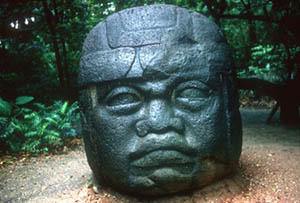
The Olmec civilization developed in the Gulf Coast region of today’s Mexico around 1600 BCE. It did not develop beside a great river, but along the coast, where there was plentiful rain that could be stored and used to irrigate fields of corn, peppers, beans, and pumpkins. The Olmecs invented the first writing system in the Americas, and probably created the long calendar perfected by the later Mayans as well. Olmec cities like La Venta featured temples to the gods and were controlled by an elite class who likely controlled access to stored water. The people built monumental stone art, like the head on this flashcard. What made Olmec civilization different from Mesopotamian or Egyptian civilization?
It did not develop along a river.
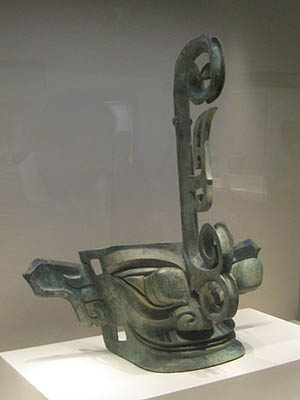
By BabelStone (Own work) [CC-BY-SA-3.0 (http://creativecommons.org/licenses/by-sa/3.0)], via Wikimedia Commons About 4,000 years ago, the Shang dynasty developed along the Yellow River in northern China. The people farmed rice and millet, and eventually built cities, like the capital of Anyang. Unlike most other early civilizations, the Shang worshiped the spirits of their own human ancestors along with gods. The Shang developed medicine, silk making, and a great bronze industry that created artwork like the mask on this card. We know from a royal tomb found at Anyang that Shang society was ruled by a powerful king who was supported by nobles and priests. What made Shang civilization different from Olmec or Mesopotamian civilization?
The Shang worshiped their human ancestors along with gods.
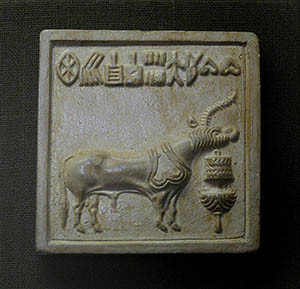
By Ismoon (talk) 17:48, 21 February 2012 (UTC) (Own work) [CC0], via Wikimedia Commons The Indus River civilization grew in what is now northwestern India and Pakistan around 2600 BCE. In cities like Mohenjo-Daro, surplus grain, peas, and dates were stored in huge granaries. Houses in the cities had underground sewers and indoor plumbing. The Indus people developed writing, seen on the seal here, but it has not yet been deciphered. Traders and artisans lived in the cities, along with a ruling class that included priests to work in the temples to the gods. What makes the Indus River civilization different from Chinese or Egyptian civilization for us today?
We can’t read their writing yet.
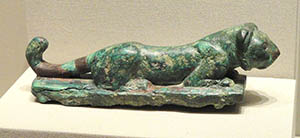
By Daderot (Daderot) [CC0 or CC0], via Wikimedia Commons Mesopotamia was the home of several ancient civilizations, beginning with Sumer, which developed between the Tigris and Euphrates rivers over 5,000 years ago. Akkad arose north of Sumer. Both had great cities, like Uruk, and developed art, literature, and complex religions with many gods. Both were conquered by and became the kingdom of Babylonia around 1900 BCE. Babylonia’s rival state was called Assyria. Each of these states had a ruling class of kings and priests, a middle class of doctors, scribes, and architects, and a large lower class of farmers. What made Mesopotamia different from China or the Indus River Valley?
It developed many different yet related civilizations. |
 |