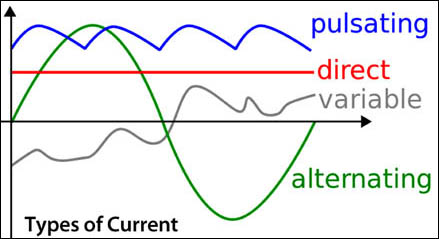
 Alternating Current changes direction in a circuit. Instead of the current flowing in the same direction over and over again, the current goes back and forth. This is the kind of current that we’ve described that is produced by electromagnetic induction. It is done by alternating the polarity (switching the north-south poles) at the generator by rotating the generator’s coil. Each half turn of the coil changes the direction of the electron flow, making the electrons move back and forth through the circuit.
 Nearly all commercial electrical energy in North America is AC and alternates at a frequency of 60 Hz (cycles per second). AC is used for commercial power generation because it can easily be transmitted great distances with little loss of energy. The current that comes into your home is AC.
The main advantage to AC over DC power is that AC voltages can be transformed into higher or lower voltages using a transformer. This makes it extremely convenient to use, as high voltages can be transmitted great distances, and changed into lower voltages as needed by the home. It can be reduced further by transformers within appliances in the home. This flexibility is very convenient.
Advantages of AC
What is an advantage of alternating current over direct current?
Alternating current can be transformed using a transformer into higher or lower voltages.
