Background:
The Hindenburg was a German passenger airship that arrived in New Jersey on May 6th, 1937, carrying 97 people. Herbert Morrison had been assigned to report the
event live, and his coverage became one of the most famous radio
broadcasts in history.
Transcript:
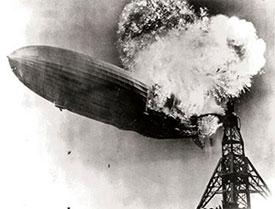 It's starting to rain again; it's... the rain had (uh) slacked up a little bit. The back motors of the ship are just holding it (uh) just enough to keep it from...It's burst into flames! Get this, Charlie; get this, Charlie! It's fire... and it's crashing! It's crashing terrible! Oh, my! Get out of the way, please! It's burning and bursting into flames and the... and it's falling on the mooring mast. And all the folks agree that this is terrible; this is the one of the worst catastrophes in the world. [indecipherable] its flames... Crashing, oh! Four- or five-hundred feet into the sky and it... it's a terrific crash, ladies and gentlemen. It's smoke, and it's in flames now; and the frame is crashing to the ground, not quite to the mooring mast. Oh, the humanity! And all the passengers screaming around here. I told you; it—I can't even talk to people, their friends are out there! Ah! It's... it... it's a... ah! I... I can't talk, ladies and gentlemen. Honest: it's just laying there, mass of smoking wreckage. Ah! And everybody can hardly breathe and talk and the screaming. I... I... I'm sorry. Honest: I... I can hardly breathe. I... I'm going to step inside, where I cannot see it. Charlie, that's terrible. Ah, ah... I can't. Listen, folks; I... I'm gonna have to stop for a minute because [indecipherable] I've lost my voice. This is the worst thing I've ever witnessed.
--Herbert Morrison, WLS Broadcast, May 6th 1937
After listening to this account, research the Hindenburg disaster on your own, using an Internet search engine like Google or Yahoo. Then, compare Morrison's version with what you've learned and with the account in the following video:

[MUSIC PLAYING] The German Zeppelin Hindenburg, queen of the skies, seen here from a universal newsreel camera plane as its sped over New York to its tragic end at Lakehurst, New Jersey, now lies at the Naval Air Station, a twisted mass of metal. Shortly after these pictures were taken showing the great skyliner saluting the millions watching it from below on its first trip of the season, the huge craft exploded while docking and blazed to a fiery end, taking the lives of almost half its 99 passengers and crew.
Hours late on a trip from Hamburg because of headwinds, the Zeppelin had to write out a thunderstorm along the Jersey coast before heading for the air station and nosing its way to the mooring masts. The wind is bad and the docking is a ticklish one, but it's all a thrill for the crowd of happy passengers eager to land after their transoceanic trip. Slowly, the big ship warps in, and the ground crews rush for the mooring lines. In another 10 minutes or so, the great aircraft would have been snugly docked, but as the passengers crowded the windows to watch, a roar and a burst of flames near the BIG tail fins turned the ship into a flaming inferno.
[DRAMATIC MUSIC]
[SCREAMING]
Passengers and crew, the fortunate among them, bailed or jumped, and were dragged to safety before the fiery furnace took their lives. Heroic work by Navy and Army men risking their lives around like white-hot skeleton snatched more than one dazed and half-burned passenger from the blazing wreckage, but for the most of those trapped in the incandescent tangle, there was no hope. It's the greatest of miracles that anyone came out of the disaster alive.
[DRAMATIC MUSIC]
Seven million cubic feet of inflammable hydrogen gas blazed up in less than a minute. The hundreds of tons of fuel oil burns for an hour or more, with its dense black smoke making a fog over the tragic scene. In all the history of air disasters, this is the worst, the most terrible. Hailed as the luxury liner of the air, the Hindenburg's horrible end has shocked the entire world. The pride of the skies reaches its journey's end.
[DRAMATIC MUSIC]
